How Credit Card Travel Points Actually Work in the Philippines
Confused about travel points? This beginner-friendly guide explains how credit card travel points actually work in the Philippines — without hype or shortcuts.
Every few days, someone posts on r/PHCreditCards:
"What's the best travel credit card in the Philippines?"
And the thread becomes a war. Chinabank fans, KrisFlyer loyalists, BDO AmEx converts. All convinced their card is the obvious answer.
There is no universal best travel card.
The card that works brilliantly for a frequent flyer who books flexible dates will disappoint someone who travels once a year on fixed holidays. The "best" card for one person's habits can genuinely be the wrong choice for another.
So this guide asks a different question.
Not "what's the best travel card?" But: which travel credit card fits how you actually travel?
If you're completely new to travel rewards, start here first: 👉 Credit Card Travel Rewards in the Philippines: A Beginner's Guide
They don't choose based on math.
They choose based on how the card looks in a promo photo. Or because a friend has it. Or because the name sounds prestigious.
The credit card community documents this pattern constantly. Four mistakes come up again and again.
The UnionBank Miles+ Visa Signature markets itself as earning "1 UB mile per ₱30 spent." That sounds exactly like the Chinabank Destinations World or the Metrobank Travel Visa Signature. But the fine print is the trap: 1.6 UB miles only equal 1 actual airline mile. The real earning rate is ₱48 per airline mile. That's 60% worse than it appears on paper.
This one hurts quietly. UnionBank Miles+ charges a 3.525% foreign transaction fee on overseas purchases. Chinabank Destinations and EastWest KrisFlyer charge only 1.7%. On a ₱100,000 overseas trip, that's a ₱1,825 difference. Enough to erase months of accumulated miles.
The Eastwest KrisFlyer World Mastercard advertises ₱12 per mile on cross-border and travel spend. It sounds incredible. But that rate only applies to a narrow set of categories. Buy groceries or pay for fuel and the rate jumps to ₱78 per mile — 6.5 times worse than the headline number.
Before picking any travel card, beginners need to ask whether miles are even the right reward type for them. More on that below.
All four mistakes come from the same place. Choosing what looks impressive over what actually matches your behavior.
Strip away the marketing and a beginner-friendly travel card has five things.
Flashy perks matter far less than these five things when you're just getting started.
Before you commit to a travel card, pause and answer three questions honestly.
This isn't a rhetorical exercise.
Research from r/PHCreditCards shows that bonus-category cashback cards can return 4% to 8.88% on spending — capped, but real. Flat-rate miles cards return around 2.67% — assuming ₱30/mile earning rate and ₱0.80/mile redemption value, which is the standard benchmark for the Philippine market.
For low spenders who don't hit cashback caps, cashback often wins. For travelers who do hit the caps and actually use their miles, miles can win. But only if the miles get redeemed before they expire.
A useful rule of thumb: if you travel internationally at least once a year and are willing to learn basic redemption, a miles card at ₱30/mile or better is worth considering. If neither condition is true, a flat-rate cashback card is simpler and gives guaranteed value.
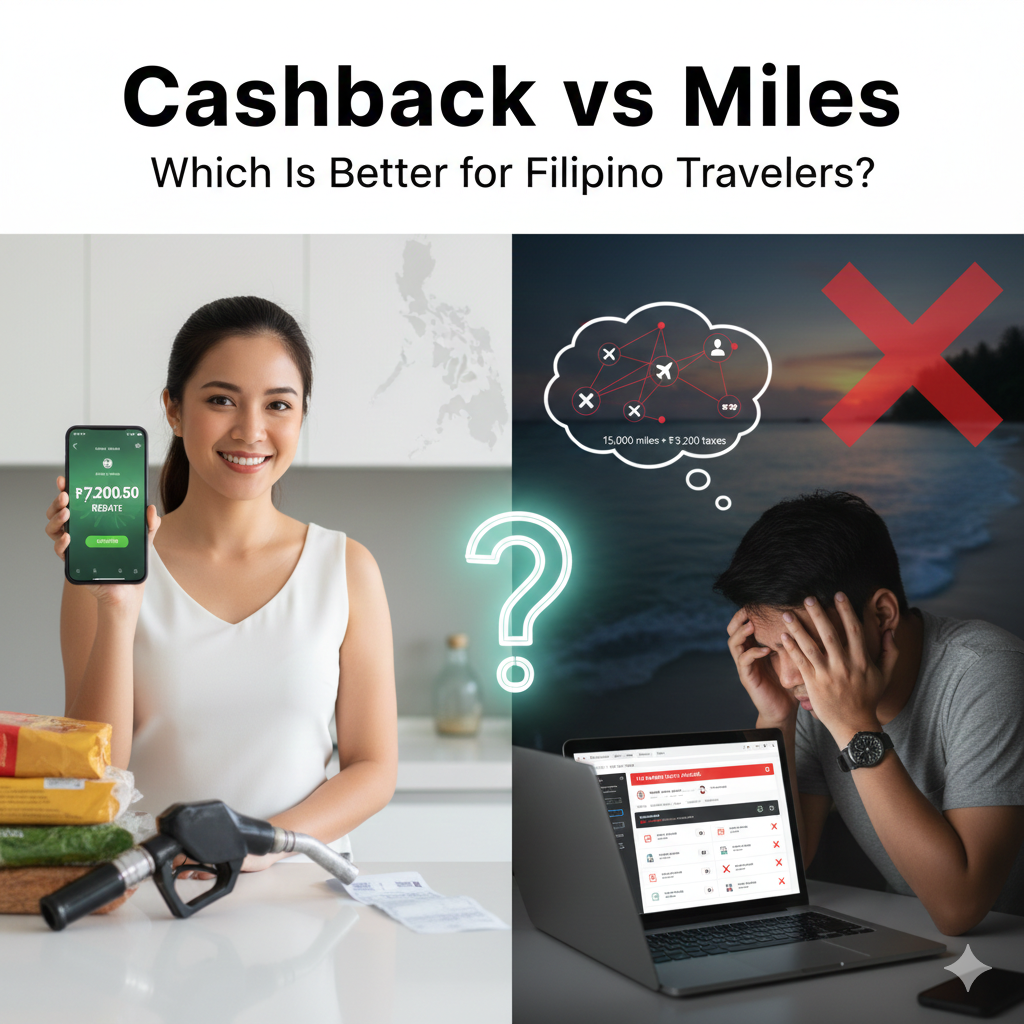
👉 Cashback vs. Miles: Which Is Better for Filipino Travelers?
Here's what to compare across cards and why each one matters.
This is the core number. Lower is better.
The flat-rate cards all land at ₱30 per mile across all transactions: Chinabank Destinations World, Metrobank Travel Visa Signature, and BDO AmEx Explorer. (Note: BDO AmEx improved from ₱40/mile to ₱30/mile as of November 2025 — a significant upgrade.)
RCBC Visa Platinum earns at ₱48/mile locally but drops to ₱25/mile overseas, which is an advantage if most of your spending is international.
EastWest KrisFlyer World earns at ₱12/mile on cross-border and travel categories. That headline sounds amazing. But locally, groceries and fuel earn at ₱78/mile. If most of your daily spending falls outside the premium categories, your average effective rate is much worse than advertised.
UnionBank Miles+ appears to earn at ₱30/mile. But the 1.6:1 conversion ratio means the real rate is ₱48 per airline mile — worse than flat-rate cards despite the identical-sounding marketing.
👉 How Miles Conversion Really Works (And Why Rates Matter More Than Promos)
Not all reward programs convert 1:1.
The cleanest cards for beginners offer 1:1 conversion — Chinabank Destinations World, Metrobank Travel Visa Signature, BDO AmEx Explorer, RCBC Visa Platinum, and EastWest KrisFlyer all work this way. UnionBank Miles+ requires 1.6 UB miles per 1 airline mile. BPI's program uses a more complex RTR Premium Points system that varies by airline partner.
For beginners, 1:1 conversion isn't negotiable. Anything more complex adds mental overhead you don't need at the start.
Annual fees range from ₱4,000 to ₱6,000 for the major travel cards.
At ₱30/mile earning rate with miles valued at ₱0.80 each, here's the annual spending needed just to earn back the fee in miles value:
Those numbers look daunting. But here's what changes the calculation: the Philippines has a strong culture of annual fee waivers.
Most banks will waive the fee if you call and ask. Filipino cardholders have developed a well-documented playbook. Call customer service and politely request a waiver. If refused, ask for a spending-based condition instead. If still refused, threaten to cancel — especially effective for active users. Banks like BPI and RCBC reportedly waive fees with minimal pushback. Metrobank and BDO may need more persistence but are still receptive.
If you get the annual fee waived — which is genuinely achievable — the entire break-even calculation disappears. Every peso you spend becomes pure miles accumulation.
👉 Annual Fees on Travel Cards: When Are They Actually Worth Paying?
One of the most underrated features beginners overlook.
Chinabank Destinations World has the widest coverage in the Philippine market: nine airline partners. Mabuhay Miles (PAL), Asia Miles (Cathay Pacific), KrisFlyer (Singapore Airlines), Qatar Airways, American Airlines, United MileagePlus, GarudaMiles, Falconflyer (Gulf Air), and AirAsia.
BDO AmEx Explorer covers six airlines plus Marriott Bonvoy and Hilton Honors — the only entry-level travel card with hotel transfer options.
Metrobank Travel Visa Signature covers three airlines: Asia Miles, Mabuhay Miles, and KrisFlyer.
EastWest KrisFlyer locks you into KrisFlyer only. UnionBank Miles+ transfers to Mabuhay Miles only.
Being locked into one airline isn't automatically bad — if you're a loyal PAL traveler or a Singapore Airlines regular, a co-branded card can make sense. But for a beginner who doesn't yet know their travel preferences, flexibility has real value.
The EastWest KrisFlyer World Mastercard has built a reputation on its ₱12/mile headline rate. For someone optimizing specifically around Singapore Airlines routes, it can work.
For most beginners, it's a trap in three ways.
First, the fast rate is narrow. The moment you buy groceries, pay utilities, or fill your tank, you're earning at ₱78/mile. That's 6.5 times slower than the advertised rate.
Second, KrisFlyer miles expire. Three years. Unlike most Philippine points programs where miles never expire, KrisFlyer resets your balance if you don't earn or redeem within that window. For an occasional traveler building slowly toward a redemption, this is a real risk.
Third, you're completely locked into one airline. If Singapore Airlines doesn't fly your preferred route, or availability is poor for your dates, the miles become effectively useless.
Speed of earning means nothing if the miles expire before you use them.
👉 Which Credit Cards Earn Miles the Fastest (Without Overspending)
You book fixed holiday dates. You prefer not to track categories or study redemption rules. The idea of optimizing rewards sounds more like homework than fun.
Honest recommendation: a cashback card might genuinely serve you better.
If you travel once a year on fixed dates, you don't have the flexibility to use miles strategically. Guaranteed cashback often beats conditional miles in this scenario.
If you're set on a travel card, consider the BDO AmEx Explorer. Lowest annual fee at ₱4,000 (free first year), recently improved to ₱30/mile, and points that never expire. The slow accumulation works if you're patient.
An even lower-commitment option: the PNB-PAL Mabuhay Miles NOW. Free for three years. Earns at ₱33/mile. PAL-focused. It's not the most flexible card in the market, but as a zero-risk entry point to learn whether travel rewards actually work for your habits, it's hard to beat.
👉 Are Travel Credit Cards Worth It If You Only Travel Once a Year?
You pay your balance in full every month. You're willing to spend a few hours learning how redemption works. You actually enjoy planning.
Recommendation: Chinabank Destinations World Mastercard.
Flat ₱30/mile across all transactions — no categories to manage. Nine airline partners for the widest possible redemption options. The 1.7% FX fee is among the lowest in the market. Miles never expire. And the ₱6,000 annual fee is reportedly the easiest to get waived, with reports of approval at just ₱12,000 in annual spending.
A popular pairing in the r/PHCreditCards community: combine Chinabank Destinations World (Mastercard) with Metrobank Travel Visa Signature (Visa). Both earn at ₱30/mile. Together they cover both card networks, both banks' promos, and Metrobank adds unlimited local lounge access at PAGSS and Plaza Premium with no visit caps.
You want the airport lounge experience. The premium card feel matters to you.
Fair enough. Just run the math first.
A PAGSS lounge visit is worth roughly ₱800 to ₱1,200. With a ₱5,000 to ₱6,000 annual fee, you need four to six visits per year just to break even on that one benefit. If you fly domestically one or two times a year, the lounge perk doesn't cover the fee on its own.
For lounge access, the Metrobank Travel Visa Signature is the most practical option: unlimited local lounge access at PAGSS and Plaza Premium with no visit cap, plus worldwide lounge access with ₱50,000 in airline spend (promo until July 2026). Annual fee of ₱5,500.
For genuinely premium cards with real lounge benefits, the Security Bank World Mastercard offers unlimited local and global lounge access plus USD 100,000 travel medical insurance — but requires ₱3,000,000 in annual income. The RCBC Visa Infinite offers 5x points overseas and Priority Pass but requires ₱2,000,000.
If you're not at those income levels, the "prestige" positioning of mid-tier cards is mostly marketing.
👉 Are Airport Lounge Access and Travel Perks Really Valuable?
Before submitting any credit card application, answer this one question:
Can I name the airline, the route, and the approximate number of miles I'd need for a redemption and explain how long it would take me to accumulate that many at my current spending?
If the answer is no, you're not ready to pick a card yet. That's completely fine.
Understanding comes before optimization.
Applying for a travel card you don't yet understand is how beginners end up with a ₱6,000 annual fee and 3,000 miles sitting in an account they'll never actually use.
Spend two hours learning how one redemption program works. Then pick the card that earns into that program efficiently.
Not the most premium. Not the most advertised. Not the one with the fastest headline rate or the most impressive brand.
The best travel credit card for you is the one that matches your real travel frequency, your actual spending patterns, and your willingness to learn how redemption works.
For most beginners in the Philippines right now, that's either the Chinabank Destinations World Mastercard, the BDO AmEx Explorer, or — depending on how often you actually travel — no travel card at all and a solid cashback card instead.
The math is not complicated once you know what to compare.
The hard part is being honest about your own habits before you apply.
| Profile | Top Pick | Why |
|---|---|---|
| Once-a-year traveler | BDO AmEx Explorer or PNB-PAL NOW | Lowest fees, no-expiry points, low commitment |
| Flexible date planner | Chinabank Destinations World | 9 airlines, flat rate, low FX fee |
| Lounge seeker | Metrobank Travel Visa Signature | Unlimited local lounges, flat rate, 1.7% FX |
| Still unsure | Flat-rate cashback card | Guaranteed value, zero complexity |
All card details verified as of February 2026. Card terms, earning rates, and annual fees are subject to change by issuing banks. Always confirm current terms directly with the bank before applying.