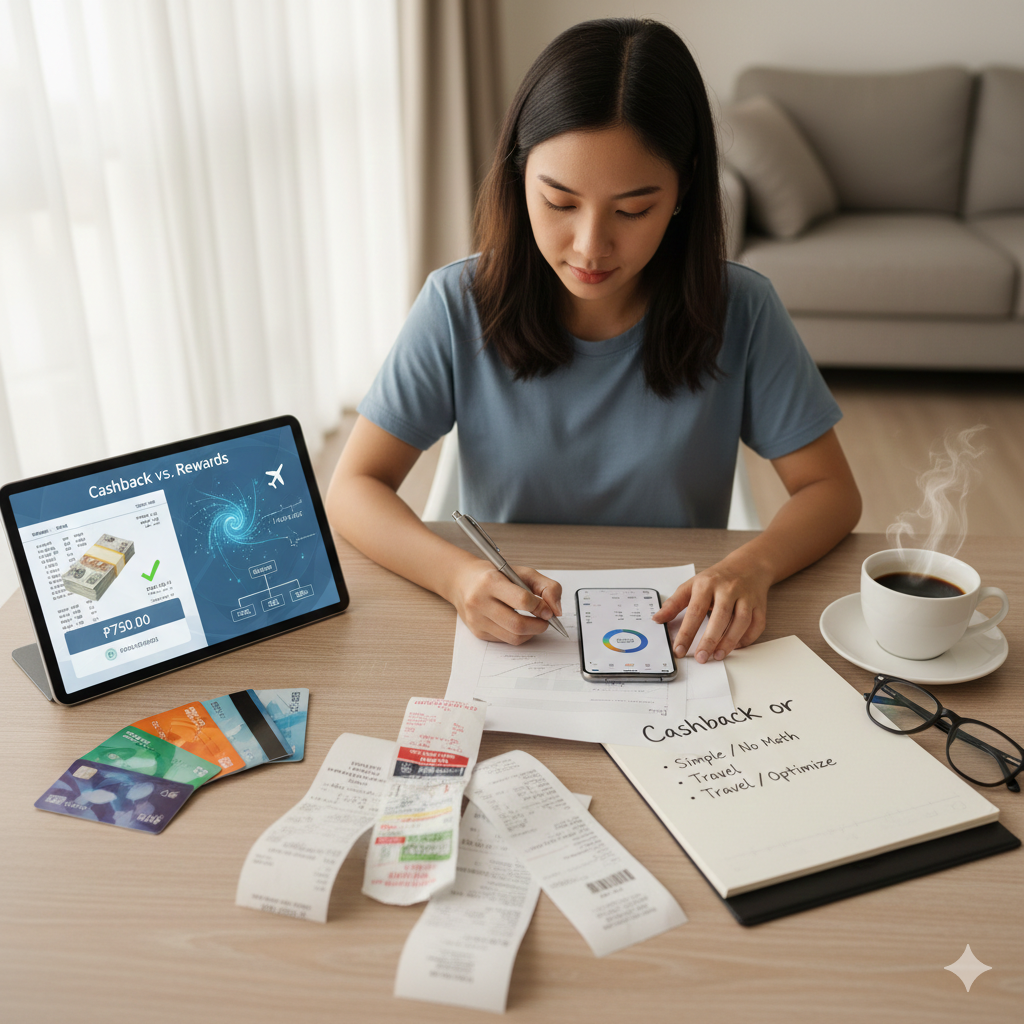
Do Credit Card Rewards Really Matter — Or Is Cashback Better?
Are credit card rewards really worth it? This honest guide explains when rewards help — and when cashback is the smarter choice.
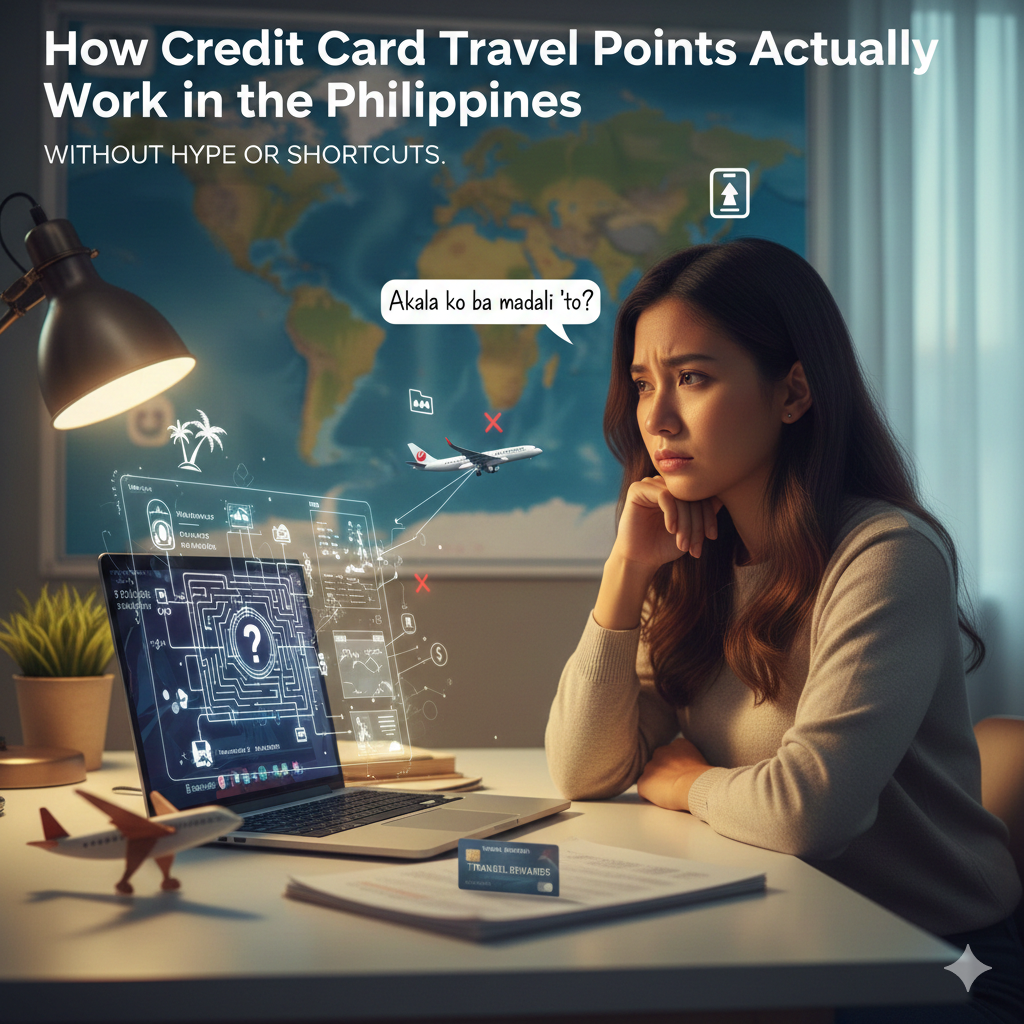
Travel Points Sound Simple Until You Try to Use Them
"Earn points. Redeem flights. Travel free."
That's what the ad said when Mika signed up for her first travel credit card.
She imagined herself booking flights to Siargao, Palawan, maybe even Japan — all "free" because of points. The brochure made it sound easy.
Three months later, she checked her points balance: 8,000 points.
She tried to redeem them for a Manila–Boracay flight. The system asked for 25,000 points. Or she could convert to airline miles, but 8,000 points only yielded 1,600 miles. Not even enough for a one-way domestic ticket.
"Akala ko ba madali 'to?" she messaged her friend.
Sound familiar?
Spend time on r/PHCreditCards and you'll see the same pattern:
This article explains how travel points actually work in the Philippines.
At their core, travel points are:
They are not:
Points only become valuable after you redeem them and that's where things get complicated.
Think of points like gift certificates. May value sila, pero hindi cash. And you can't use them anywhere, anytime.
When Mika's officemate told her "I flew to Hong Kong for free," what he didn't mention was: he spent ₱500,000 over two years to earn those miles. And he still paid ₱4,500 in taxes and fees for the "free" flight.
Ito yung:
Pros: Flexible and easier for beginners.
Cons: Conversion rates vary wildly. Value is often unclear. Sometimes as low as 0.3–0.9% effective rebate.
Mika's card earned 1 point per ₱30 spent. She needed 5,000 points to convert to 1,000 airline miles. To get 25,000 miles for a one-way international flight, she'd need to spend ₱3.75 million.
Ito naman yung:
Pros: Potentially high value on award tickets.
Cons: Complex rules, limited seat availability and may expiry (kailangan active ka or mawawala ang miles).
Mika's friend Janet had 30,000 Mabuhay Miles. She tried to book a Manila–Singapore flight for her birthday.
The website showed "no award seats available" for her preferred dates. She tried different dates. Still nothing. She finally found availability — three months later, on a Wednesday, at 6 AM.
"Sige na lang," she thought. She clicked through. The confirmation page showed: 25,000 miles + ₱6,800 in taxes and fees.
Examples:
These feel valuable pero often hindi naman talaga bumababa ang actual travel costs mo.
Mika's premium card came with free lounge access. She used it once at NAIA Terminal 3. Free coffee, free sandwiches, free Wi-Fi.
Nice, yes. But did it reduce her airfare? No.
Lounge access is comfort, not savings.
Travel points are usually earned based on:
You don't earn points faster just because a card is labeled "travel."
Many beginners assume all spending earns points equally. It doesn't.
Mika compared two cards:
Which one actually earns faster for someone who books Grab flights online? Card B.
Marketing ≠ actual value.
Most travel points must be converted before use.
This involves:
Mika's experience:
She earned 5,000 bank points after three months of spending. She converted them to 1,000 airline miles. The system required a 5,000-point minimum, so she waited another month to hit it.
When she finally converted, the system said: "Processing time: 7–10 business days."
Two weeks later, the miles appeared in her airline account.
By then, the promo fare she wanted was gone.
This step alone reduces perceived value significantly.
Even when redeeming miles, you often still pay:
Real example: Mika's friend finally redeemed miles for a "free" Manila–Tokyo flight. The confirmation email showed:
"Free" flight. ₱7,200 out of pocket.
This is why many Reddit users feel disappointed after their first redemption. The surprise cash you still owe? That's normal.
Many users admit: "I spent more just to earn miles."
If earning points changes your spending behavior, rewards stop being rewards.
Mika started doing this without realizing it.
She'd buy groceries with her card instead of cash — okay, that's fine. But then she started buying things she didn't need just to hit the next 5,000-point milestone. A new bag. Another pair of shoes. A gadget on sale.
"At least I'm earning points," she told herself.
Except: she spent ₱8,000 extra that month to earn 267 points. Those points were worth maybe ₱50 in redemption value.
She lost ₱7,950.
Signs you're chasing points:
Bottom line: If the points cost you more (in extra spending or interest) than they're worth, you're losing money.
Travel points work best when:
They fail when:
Mika's coworker, Ben, uses points well. He's been using the same card for five years. He pays in full every month. He uses it for expenses he'd make anyway — groceries, utilities, gas.
Once a year, he converts his points and books a trip. He's flexible with dates. He doesn't expect "free" — he just sees it as a small rebate.
Last year, he flew to Bangkok and paid ₱4,000 in taxes for a flight that would've cost ₱12,000. Not free. But a decent discount.
That's realistic.
If travel points make your finances harder to understand, stop.
Cashback is often better early on. Once you're comfortable managing credit and paying in full, then you can explore points kung interesado ka.
Mika switched to a cashback card after six months. She earns 2% back on groceries, 1% on everything else. Simple. She knows exactly what she's getting.
You don't need travel points to travel well.
They're a bonus, not a requirement.
Mika still travels. She books promo fares. She plans ahead. She uses her cashback to offset costs.
She doesn't feel like she's missing out.
Focus on:
If points fit naturally into that? Great. If not? You're not missing out.
Travel rewards are a tool, not a lifestyle. Use them wisely, or don't use them at all.