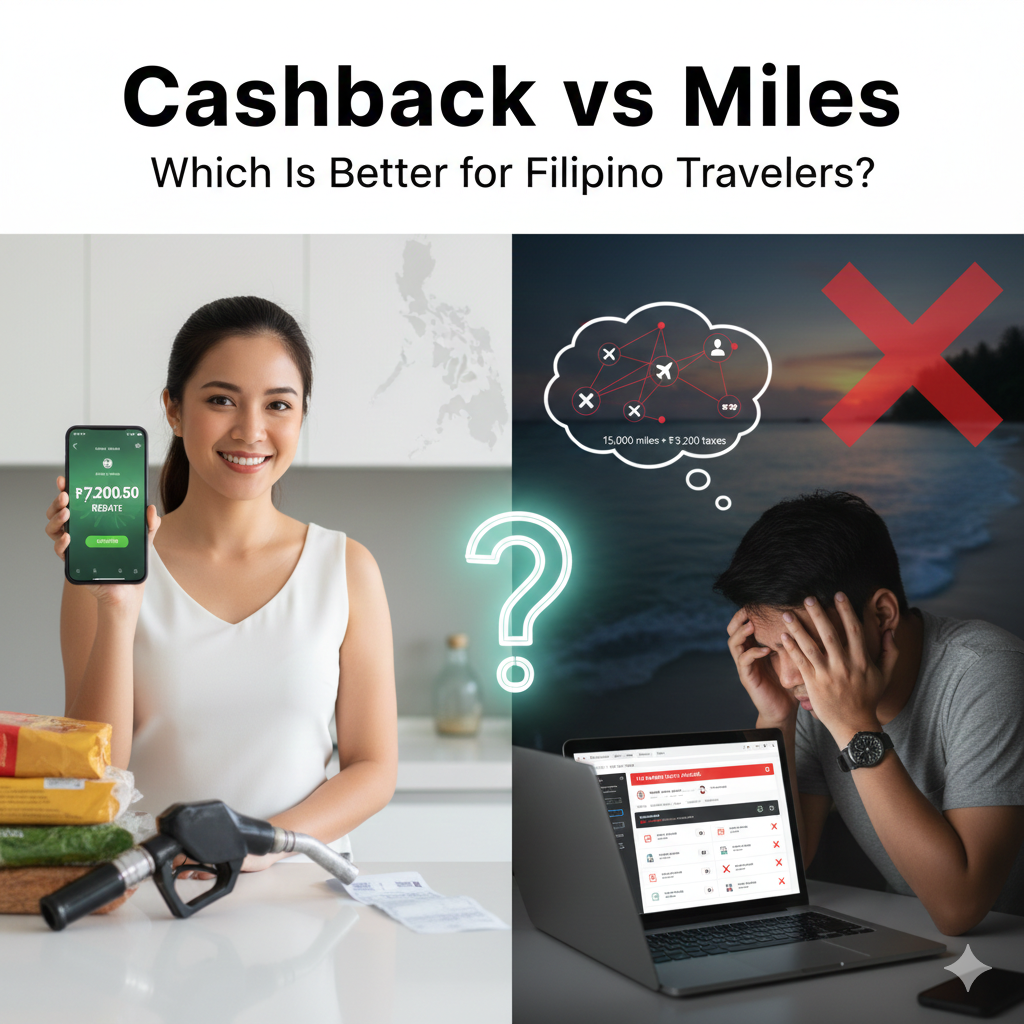
How Credit Card Travel Points Actually Work in the Philippines
Confused about travel points? This beginner-friendly guide explains how credit card travel points actually work in the Philippines — without hype or shortcuts.

The Most Misunderstood Number in Travel Rewards
One of the biggest misconceptions about travel rewards is this:
"I earned 50,000 miles. That must be worth a lot."
But worth how much?
₱50,000? ₱25,000? ₱10,000?
The answer: it depends.
Miles don't have a fixed peso value. Their value depends entirely on how you use them, and that's where disappointment often starts.
Example:
Gina earned 30,000 Mabuhay Miles after a year of spending on her credit card.
She was excited. "That's like having ₱30,000 worth of free flights, right?"
She tried to book a round-trip flight from Manila to Hong Kong. The system wanted 32,000 miles. She didn't have enough.
She tried Manila–Cebu instead. It needed 15,000 miles. She clicked through.
The confirmation page showed:
The same flight on a promo fare was ₱2,800.
She paid 15,000 miles + ₱2,100 to save ₱700.
"Wait," she thought. "So my 15,000 miles were only worth ₱700?"
That's 4.6 centavos per mile. Not ₱1 per mile.
Unlike cash:
Their value changes depending on:
This variability is why 1 mile is never equal to ₱1.
Philippine Airlines' Mabuhay Miles and other programs publish how many miles you need per route, but they don't assign a fixed peso value to each mile. The peso value depends on the cash fare you're replacing.
Example:
Rico redeemed 50,000 miles for a Manila–Tokyo round trip.
The cash ticket price was ₱35,000. He still paid ₱7,200 in taxes and fees.
Value he got: ₱35,000 - ₱7,200 = ₱27,800 from 50,000 miles.
That's about ₱0.56 per mile.
His friend Mae redeemed 50,000 miles for a Manila–Boracay round trip (yes, may connecting flights involved).
The cash ticket price was ₱8,000. She still paid ₱2,500 in taxes and fees.
Value she got: ₱8,000 - ₱2,500 = ₱5,500 from 50,000 miles.
That's about ₱0.11 per mile.
Many experienced users estimate miles using a simple formula:
Value per mile = (cash ticket price - taxes/fees) ÷ miles needed
For Filipino travelers, miles usually have a floating value somewhere around:
Beginners often assume they'll get the best-case scenario.
They usually don't.
Real PH example from Reddit:
One user calculated a Manila–Hong Kong economy round trip:
That's roughly a 1% return on card spend (assuming 1 mile per ₱48 spend).
Even "free" flights often require:
Philippine flights include specific charges like the Philippine Travel Tax (about ₱1,620 for nationals) plus airport and other fees, which typically must be paid in cash even on award tickets.
These can reduce perceived value dramatically.
Example:
Jun redeemed 25,000 miles for a Manila–Singapore one-way flight.
The system showed:
A promo fare for the same flight? ₱9,500.
He saved ₱2,700. That's ₱0.11 per mile.
"Akala ko libre," he told his friends. "Pero ₱6,800 pa rin binayad ko."
This is one of the biggest Reddit complaints.
Miles are useless if:
If you have fixed travel dates, your miles' value drops.
Example:
Lea saved up 40,000 Mabuhay Miles. She wanted to fly Manila–Davao for her cousin's wedding on July 15.
She checked the award calendar. No availability.
She tried July 14. Wala.
July 16. Wala pa rin.
The only availability? July 22. One week after the wedding.
"Anong silbi nito?" she thought.
She booked a promo fare instead. ₱3,200.
Her 40,000 miles? Still sitting there.
Common reactions:
This is normal — not a failure.
Users in PH forums report frustration when small mile balances (like 1,200 PAL miles) can't be used for meaningful flights, or when they realize they need hundreds of thousands of pesos in spend to get a modest domestic ticket.
Example:
Paolo earned 12,000 miles after six months of spending.
He tried to redeem for a Manila–Cebu flight. The system wanted 15,000 miles.
Kulang siya.
He tried converting more bank points to miles. The minimum conversion was 5,000 points.
He didn't have enough bank points either.
He gave up.
"Parang ang hirap naman," he said. "Mas okay pa yung cashback. At least alam mo kung magkano."
Many find that alternative uses of bank points (like gift certificates or statement credits) can yield similar or slightly better peso value than converting to miles, especially for short domestic routes with low base fares but high taxes.
Miles work best when:
They reward patience, not urgency.
Example:
Brent redeemed 80,000 miles for a Manila–Los Angeles business class one-way.
The cash ticket price? ₱180,000.
He paid ₱12,000 in taxes and fees.
Value he got: ₱180,000 - ₱12,000 = ₱168,000 from 80,000 miles.
That's ₱2.10 per mile.
For him, it was worth it. But he:
That's not most beginners.
Bank points:
Airline miles:
For beginners, bank points often feel more "real" kasi you can use them for things other than flights.
Think of miles as:
"A discount that only applies in certain situations."
Not as savings. Not as income.
If you redeem well, you might get 1–2% back on your spending.
If you redeem poorly — or don't redeem at all — you get nothing.
Mental model:
One Reddit user put it this way:
"Miles are like coupons. Pwede kang mag-save ng malaki kung sakto yung item na gusto mo. Pero kung wala yung item, or expired na, or kailangan mo ng 10 coupons pero 9 lang meron ka — walang silbi."
That's accurate.
Never value miles higher than cashback until proven otherwise.
This mindset protects you from regret.
Don't assume your miles are worth ₱1 each. Don't assume you'll get "free" flights. Don't assume redemptions will be easy.
Instead, assume miles are worth roughly the same as cashback — maybe slightly better if you're lucky.
Then, if you get more value? Bonus.
But you won't be disappointed if you don't.
Miles aren't scams — but they aren't magic either.
They reward a specific type of user:
If that's you, miles can work.
If it's not? Cashback is probably better.
Last story:
Tina used to hoard miles. She'd track every point, every conversion, every promo.
She redeemed once a year — usually for a domestic flight. She'd save maybe ₱2,000–₱3,000.
One day she did the math:
"Worth it ba?" she asked herself.
She switched to cashback.
Now she earns ₱6,000–₱8,000 a year in cashback. Walang stress. Walang tracking.
"Mas simple," she says. "And honestly, mas sulit."
Be honest about whether miles fit your life.
Because they reward patience, and not everyone has the time or energy for that.