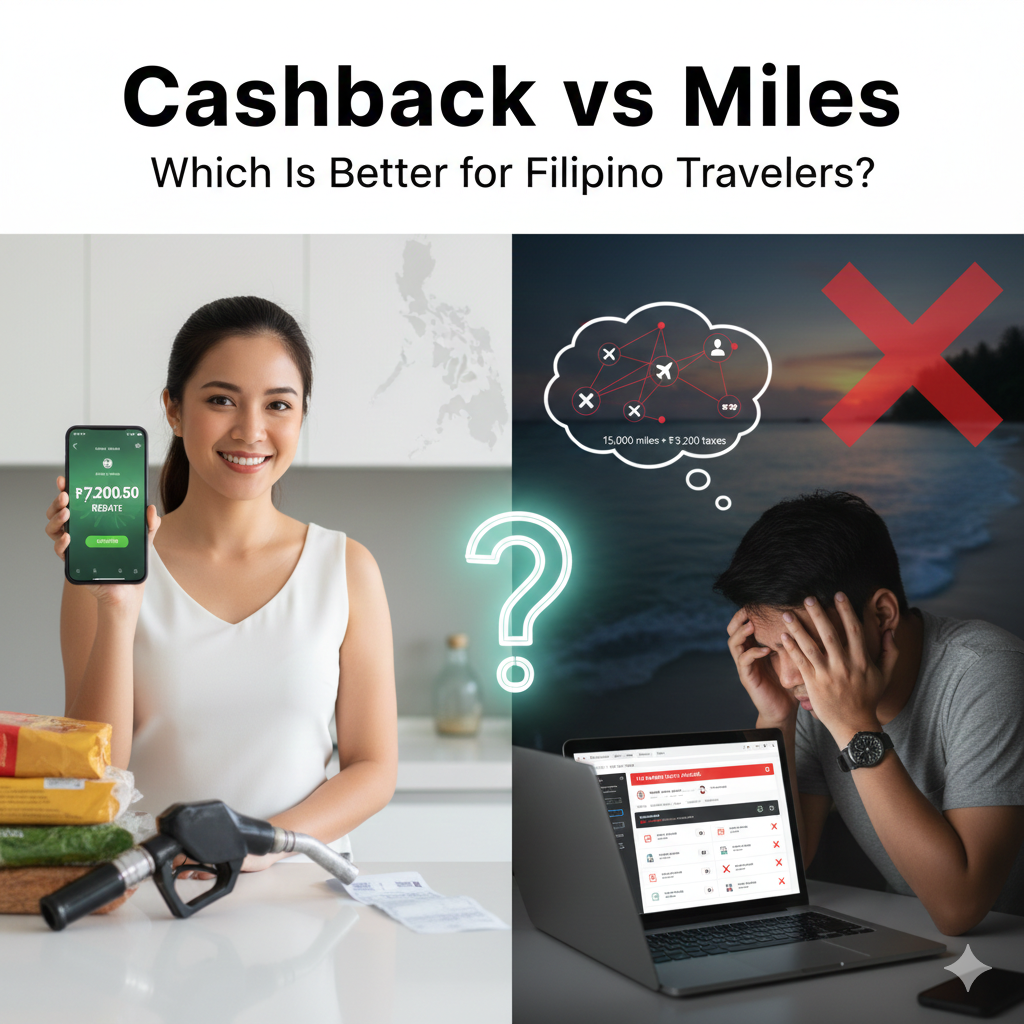
Cashback vs Miles: Which Is Better for Filipino Travelers?
Cashback or miles? This practical guide explains which credit card rewards actually make sense for Filipino travelers — especially beginners.
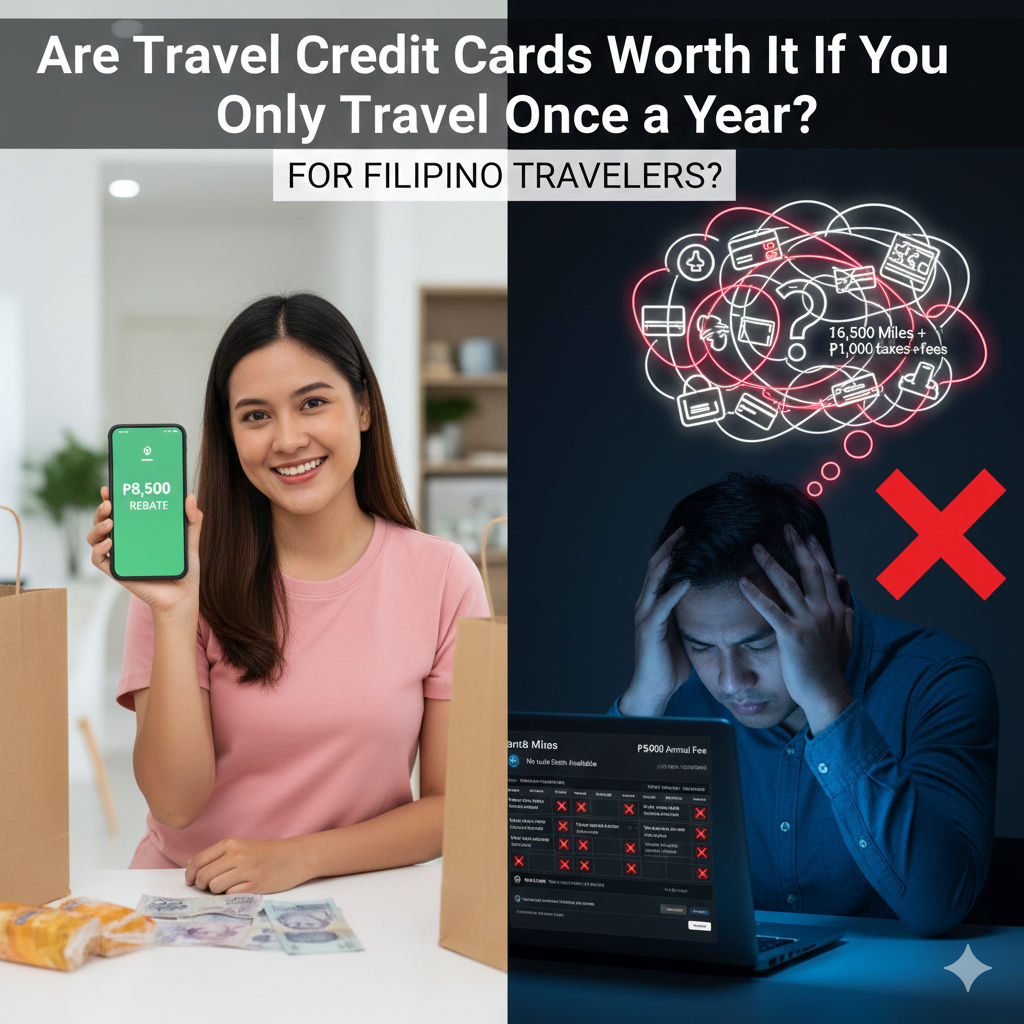
"I Only Travel Once a Year. Is a Travel Card Still Worth It?"
This is one of the most honest questions on r/PHCreditCards:
"I only travel once a year. Does a travel credit card even make sense for me?"
The short answer is uncomfortable but honest: for many people, no.
That doesn't mean travel cards are bad. It means they're often misaligned with how people actually live and travel.
Last month, someone posted: "Got a travel card kasi mukhang sulit. But I only travel pag Christmas, going home sa province. Worth it ba?"
The replies were split.
Some said: "Keep it, you'll travel more eventually."
Others said: "Cancel it. You're paying for features you don't use."
This article helps you decide realistically, not aspirationally.
Travel credit cards are appealing because they:
Walk into any bank branch and you'll see the posters: a couple on a beach. A business traveler in a lounge. Someone sipping wine in business class.
The message is clear: This could be you.
Banks know that travel is emotional. But emotions don't pay annual fees — cash flow does.
Example:
Kat saw an ad for a travel card: "Earn miles on every purchase. Fly free."
She imagined herself in Boracay, Japan, maybe Europe someday.
She signed up.
Annual fee: ₱4,500.
She didn't think much of it at the time. "I'll earn it back," she thought.
Most PH travel cards come with:
If you travel once a year, you must ask:
"Will I realistically earn more value than the fee?"
If the answer is uncertain, that uncertainty usually resolves to "no."
Kat's reality:
Annual fee: ₱4,500.
She spent ₱15,000 a month on her card. That's ₱180,000 a year.
Her card earned 1 mile per ₱35 spend. So she earned around 5,143 miles in one year.
She needed 15,000 miles for a one-way Manila–Cebu flight (economy, saver award).
Kulang siya. And her miles were set to expire in 18 months.
"Wait, so kailangan ko mag-spend pa?" she asked herself.
Let's simplify.
To break even on a travel card, you must:
For once-a-year travelers, this often requires higher spending than expected.
Example:
Let's say your travel card has a ₱4,000 annual fee.
To beat that fee purely via miles, kailangan mo:
Many casual travelers in PH don't hit that level of spending. And even if they do, redemptions aren't always easy.
PH comparison sites stress that air miles cards "take time to earn those points and redeem" — often requiring years of spending, which clashes with low, irregular travel frequency.
Travel rewards don't always align with your schedule.
If you:
Redemptions become harder, not easier.
Example:
Jun travels once a year — always in December, going home to Iloilo for Christmas.
He saved up 20,000 miles. He tried to book a Manila–Iloilo award flight for December 20.
The system said: "No award seats available."
He tried December 19. Wala.
December 21. Wala pa rin.
The only availability? January 8. Mid-week. 6 AM.
"But I need to be there by December 20," he thought. "And I have to be back by the 27th for work."
He gave up. He booked a promo fare instead. ₱3,200.
His miles are still sitting there.
This is where many Reddit users feel disappointed.
Cashback:
For people who travel occasionally, cashback often provides more real-world value.
Local guides describe cashback cards as ideal for "laidback and steady" spenders who just want predictable rebates on regular expenses — hindi yung "free trips to Japan or Korea."
Cashback cards in PH typically give 0.5–8% back in pesos (depending on category and caps), with simpler rules and often lower or waiver-eligible annual fees than travel cards.
Example:
Marge used to have a travel card. Annual fee: ₱3,800. She earned miles slowly. She rarely redeemed.
She switched to a cashback card. Annual fee: ₱1,500 (waived if you spend ₱50,000/year, which she does).
She earns 5% back on groceries, 2% on utilities, 1% on everything else.
Last year, she earned ₱8,500 in cashback.
She used ₱5,000 of it to offset her Cebu Pacific ticket for her annual trip to Palawan. The rest, she used for grocery.
A common regret:
"I spent more just to make the card worth it."
If you change your spending to justify a travel card, the card is costing you — not rewarding you.
Articles and forums warn that many people end up forcing spend "to make the card worth it," effectively losing money trying to justify an annual-fee travel card.
Example:
Bea got a travel card with a ₱5,000 annual fee.
After six months, she realized she wasn't earning miles fast enough.
So she started using the card for everything. Even when it didn't make sense.
She bought a new TV on installment. "At least I'm earning miles."
She booked a hotel through the bank's portal instead of Agoda — even though Agoda was ₱2,000 cheaper. "But I'll earn bonus miles."
She signed up for a gym membership she didn't really want. "I need to hit ₱200,000 spend this year to maximize the card."
At the end of the year, she calculated:
She lost ₱15,120.
"Tanga lang," she told her friend. "Nag-aksaya lang ako trying to justify the card."
It might work if:
Notice that travel frequency isn't the only factor — behavior matters more.
Some cards occasionally offer strong welcome bonuses or first-year fee waivers that temporarily flip the math in your favor. But you still need realistic spend and a plan to use the miles before expiry.
Example:
Rafael travels once a year — always to Singapore to visit his sister.
He has a travel card with a ₱6,000 annual fee.
But:
For him, it works. Kasi his spending is high and consistent, and he knows how to play the game.
But he's the exception, not the rule.
Many Filipinos do better by:
Travel becomes simpler and often cheaper.
Example:
Lino and his wife used to both have travel cards. Combined annual fees: ₱9,000.
They'd stress about hitting bonuses, tracking miles, finding redemptions.
"Parang trabaho na," his wife said.
They switched to cashback cards. Combined annual fees: ₱2,000 (both waived because of their spending).
Now they just:
Last year, they earned ₱12,000 in cashback combined. They used ₱8,000 for their Palawan trip. The rest went to bills.
"Mas peaceful," Lino says. "And honestly, mas sulit pa."
Ask yourself:
If these feel uncomfortable, a travel card may not be right yet.
One more check:
Pull out your last 12 months of spending. Did you:
If you answered "no" to any of these, it's a sign.
You don't "graduate" financially by getting a travel card.
You graduate by using money intentionally.
A travel card isn't a status symbol. It's a tool.
And like any tool, it only works if it fits the job.
Final story:
Dani canceled her travel card last year.
Her friends asked: "Why? Sayang naman."
She said: "Sayang yung annual fee if I'm not using it properly."
She switched to a simple cashback card. No pressure. No stress.
This year, she still traveled — Siargao, one week, promo fare. She paid cash. She used her cashback to buy pasalubong.
She didn't feel like she was missing out.
"Travel cards are for people who travel a lot or spend a lot," she says. "I'm neither. And that's okay."
That's the real answer.