How Credit Card Travel Points Actually Work in the Philippines
Confused about travel points? This beginner-friendly guide explains how credit card travel points actually work in the Philippines — without hype or shortcuts.
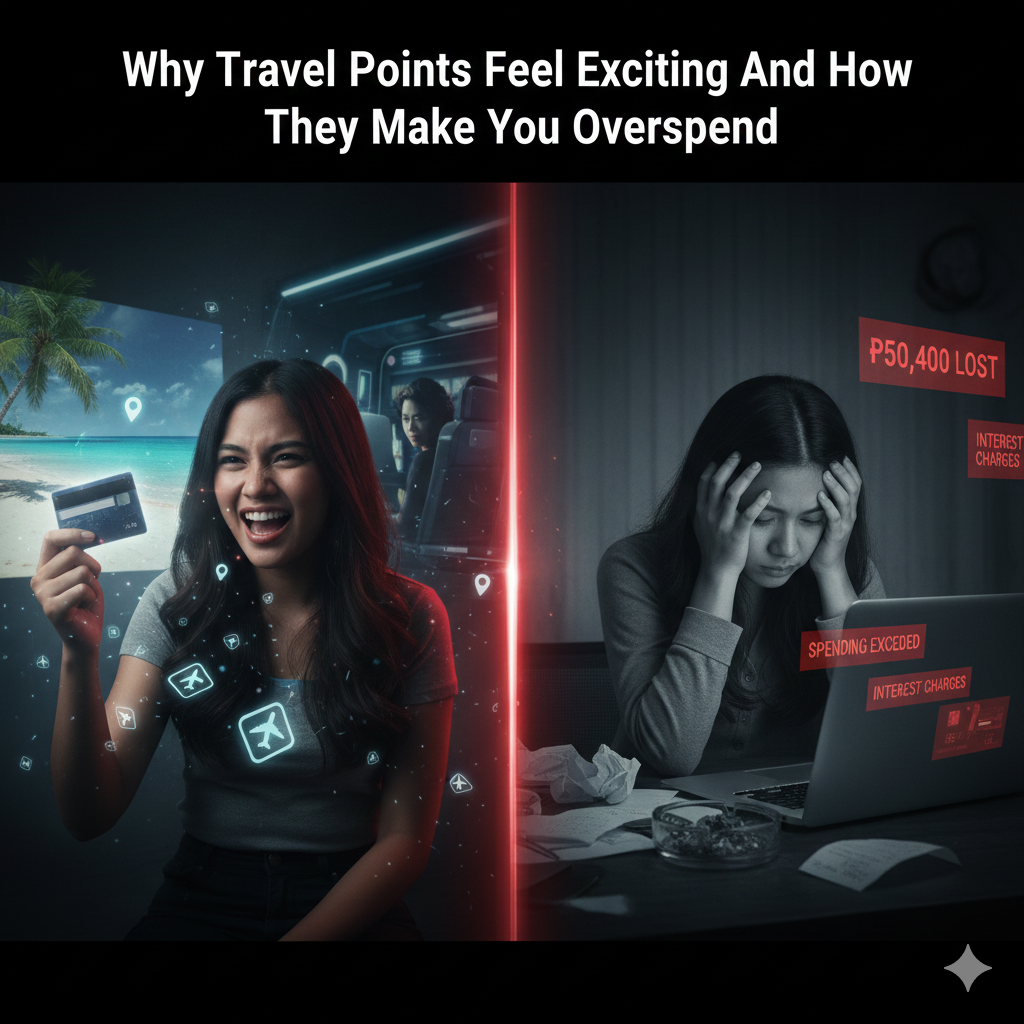
"At Least I Earned Miles" Is a Dangerous Sentence
Spend enough time on r/PHCreditCards and you'll eventually see a post like this:
"I wouldn't normally buy this, but at least I earned miles."
That sentence reveals the hidden cost of travel rewards.
Travel points don't just reward spending. They influence it. And for many Filipinos, that influence leads to higher expenses, not cheaper travel.
Example:
Janet needed new running shoes. She found a pair on sale for ₱3,200.
Then she saw another pair. ₱5,800. Premium brand. Better design.
She hesitated.
Then she remembered: "I'm using my miles card. At least I'll earn points."
She bought the ₱5,800 pair.
She earned 194 miles (at 1 mile per ₱30 spend). Those miles were worth maybe ₱155 if she redeemed perfectly.
She spent ₱2,600 extra to earn ₱155 worth of miles.
She lost ₱2,445.
But in the moment? It felt okay. Because "at least I earned miles."
This article explains why travel points feel so exciting, how they change behavior, and what you can do to protect yourself.
Cashback is boring. Miles feel special.
Psychologically, travel points benefit from:
These elements trigger excitement — even when the financial value is unclear.
Neuroscience research shows that credit cards activate the brain's reward centers more strongly than cash, especially around anticipation of a purchase. Swiping feels good even before you think about the price.
Rewards programs add another layer: points, miles, and tiers feel like a game with progress bars and "levels," which creates a goal-chasing mindset similar to loyalty programs and casino mechanics.
Example:
Carlo checks his Mabuhay Miles balance: 12,000 miles.
He needs 15,000 for a Manila–Cebu flight.
"Konti na lang," he thinks. "Just ₱105,000 more in spending and I'll hit it."
He starts looking for things to buy.
A new phone case. Groceries he could've bought next week. A gift for his mom's birthday — three months early.
He hits 15,000 miles.
But he spent ₱105,000 to earn ₱700 worth of flight value (after taxes and fees).
Cashback would've been ₱1,050 (at 1%).
He lost ₱350. But it felt like winning.
Cashback feels like a small, rational refund. But miles are framed as "future trips, upgrades, holidays" — so they feel aspirational and emotionally loaded even when the actual peso value is modest.
Travel points create a subtle shift in how you think about purchases:
Instead of asking: "Do I need this?"
People ask: "How many miles will I earn?"
That shift is where problems begin.
Behavioral research highlights "mental accounting": people treat rewards as a gain that offsets spending, which makes unnecessary purchases feel acceptable "because of the points."
Example:
Gina sees a sale at Zalora. ₱8,000 for a dress she doesn't need.
Normally, she'd skip it.
But then she remembers: her card is running a 3x points promo on online shopping.
"I'll earn 800 points," she thinks. "That's almost 1,000 miles if I convert."
She buys the dress.
She wore it once. It's been in her closet for six months.
The 800 points? Still sitting in her account. Unconverted. Unused.
She justified ₱8,000 of spending for a reward she hasn't even claimed.
This is exactly how people end up saying versions of "I wouldn't normally buy this, but at least I got miles/cashback" — which research frames as classic rewards-driven overspending rather than rational shopping.
Credit cards already reduce spending friction. Rewards reduce it further.
Why credit cards feel easier to spend:
Studies show credit cards reduce the "pain of paying," because you don't see cash leave your hand, and the bill arrives weeks later. This separation makes prices feel less real in the moment.
Why rewards make it even easier:
When you add rewards, the card is not just a payment tool — it's also a source of small wins and dopamine hits, which further lower your resistance to spending and increase impulse buys.
Combined effect:
This is why many users don't notice overspending until statements arrive.
Example:
Ben uses his card for everything. Groceries. Gas. Coffee. Online shopping. Grab. Netflix.
He feels good. "I'm earning miles on every purchase."
At the end of the month, his statement arrives: ₱42,000.
His usual monthly spend? ₱28,000.
"Paano nangyari 'to?" he wonders.
He checks his transactions. Small purchases. ₱200 here. ₱500 there. ₱1,200 for something he forgot he bought.
Nothing felt big in the moment. But it all added up.
The miles he earned? 1,400 miles. Worth maybe ₱1,100 if redeemed perfectly.
He overspent ₱14,000 to earn ₱1,100 worth of rewards.
Filipino-focused pieces on cashback note that tiered and promo-based rewards are designed to encourage higher card usage and loyalty, which benefits banks most if users aren't tracking their budgets closely.
Common admissions on r/PHCreditCards:
None of these start with bad intentions.
They start with incentives.
Real Reddit quote (paraphrased):
"I needed to spend ₱30,000 in 3 months to get the welcome bonus. I hit it in 6 weeks. Looking back, I don't think I needed half of what I bought. But the bonus felt important at the time."
Articles note that threshold-based and tiered promos (e.g., spend X to unlock bonus cashback/miles) exploit the "goal-gradient effect," pushing consumers to spend more just to hit the next tier.
Another example:
Tina's card offered: "Spend ₱50,000 this month, get 5,000 bonus miles."
She was at ₱47,000 by the 25th.
"Just ₱3,000 more," she thought.
She bought a new bag. ₱3,500.
She hit the bonus.
But she didn't need the bag. And the 5,000 bonus miles? Worth maybe ₱4,000 if redeemed perfectly.
She spent ₱3,500 to earn ₱4,000. Sounds okay, right?
Except: she wouldn't have spent the ₱3,500 at all if the promo didn't exist.
So she didn't "save" ₱500. She lost ₱3,500.
When rewards encourage spending:
Example:
Ryan's statement: ₱35,000.
Minimum payment: ₱1,750.
He thinks: "I'll just pay the minimum this month. Kailangan ko ng pera for other things. And at least I'm still earning miles on this balance."
Wrong.
Interest rate: 3.5% per month (42% per year).
Next month's interest: ₱1,225.
The miles he earned on that ₱35,000? About 1,167 miles (at 1 mile per ₱30). Worth maybe ₱930 if redeemed perfectly.
He paid ₱1,225 in interest to earn ₱930 in miles.
He lost ₱295. And that's just one month.
This is how "free travel" becomes expensive debt.
Beginners are more vulnerable because:
Guides and bank education in the Philippines repeatedly warn that lack of financial discipline and misunderstanding of interest charges are key reasons Filipinos get into card trouble, even when they start with good intentions.
Beginners often overvalue points and underestimate interest. One missed or partial payment can wipe out an entire year's worth of rewards, turning "free travel" into expensive debt.
Example:
Liza got her first travel card. She was excited to "hack travel."
She spent ₱15,000 a month. After six months, she had 3,000 miles.
One month, she couldn't pay in full. She paid ₱8,000 out of a ₱15,000 balance.
Interest on the remaining ₱7,000: ₱245 the first month. Then ₱253. Then ₱261 as the balance compounded.
By the time she paid it off three months later, she'd paid ₱780 in interest.
Her 3,000 miles? Worth maybe ₱2,400 if she redeemed perfectly.
But she never redeemed them. They expired.
She paid ₱780. She earned ₱0.
Experience helps — but only if you survive the learning curve.
Travel rewards are safer when:
If rewards change behavior, they're not helping.
Example:
Marco uses his miles card for three things:
Total: ₱20,000 a month. He'd spend this anyway, card or no card.
He pays in full every month. Automatic bank transfer on the due date.
After a year, he has 8,000 miles. He redeems for a Manila–Cebu flight and pays ₱2,200 in taxes. The same flight would've cost ₱5,500.
He saved ₱3,300. And he didn't change his spending at all.
That's rewards done right.
If you wouldn't buy it without rewards, don't buy it with rewards.
This one rule prevents most travel-reward regrets.
Expert advice across sources converges on this guardrail: only use cards for spending you'd do anyway, pay statements in full, and track your total spending — not just your rewards balance.
Test yourself:
Before every purchase, ask:
"Would I buy this if this card had no rewards?"
If the answer is no, don't buy it.
If the answer is yes, proceed.
Simple. Effective. Protects you from yourself.
Cashback:
Miles:
The psychological difference matters.
Cashback doesn't make you feel like you're "winning." It just gives you money back.
Miles make you feel like you're playing a game. And games are designed to keep you engaged — which often means spending more.
Local articles point out that threshold-based rewards favor higher-income users and can tempt lower-income cardholders to "stretch" just to qualify, amplifying risk for people with less buffer.
Best practices:
If rewards add stress, simplify.
For Filipinos specifically, starting with easier, transparent tools like cashback (and only moving into complex travel rewards once habits and knowledge are solid) fits the pattern that financial literacy is the main protection, not the card type itself.
Example:
After two years of struggling with a miles card, David switched to cashback.
He earns 3% on groceries, 1% on everything else.
He spends the same ₱25,000 a month he always did.
He earns ₱5,400 a year in cashback.
Walang stress. Walang tracking. Walang temptation to overspend.
"Mas simple," he says. "And honestly, mas peaceful."
Travel points are designed to feel good.
Your job is to make sure they also make financial sense.
Don't let the thrill of earning miles cost you more than the miles are worth.
Last story:
Nina used to chase every promo. Every bonus. Every tier.
She'd buy things she didn't need. She'd time purchases to hit spending thresholds. She'd stress about conversions and redemptions.
One day she calculated everything:
She lost ₱50,400.
"I thought I was winning," she said. "Pero talo pala ako the whole time."
She canceled her travel card. She switched to cashback.
Now she only buys what she needs. And she sleeps better.
That's the real win.