Best Credit Cards for Travel Points in the Philippines (Beginner-Friendly)
Looking for a travel credit card? This beginner-friendly guide explains what actually matters when choosing travel cards in the Philippines — without hype.
"Earn miles with every purchase."
You see that line on almost every travel credit card ad in the Philippines. And most beginners assume all travel rewards work the same way.
They don't.
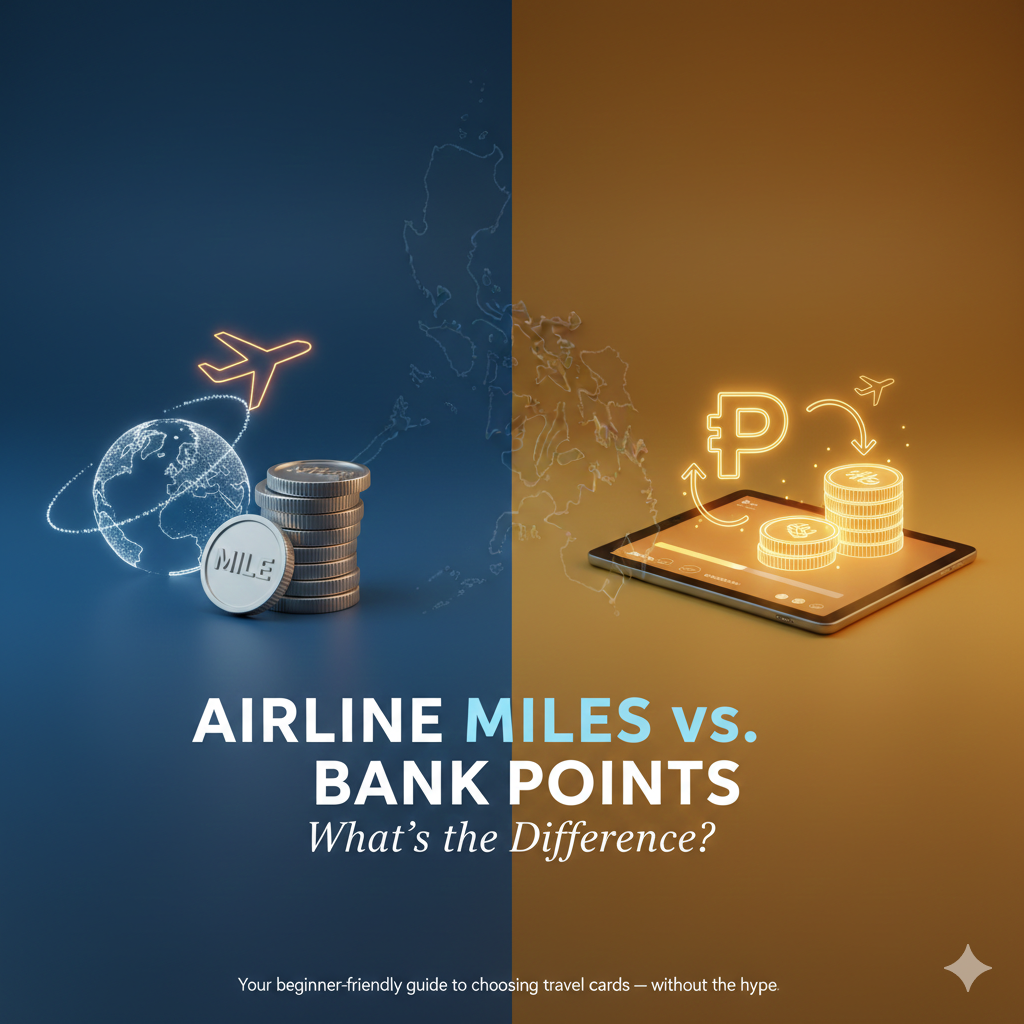
There are actually two very different systems sitting behind that phrase. Airline miles live inside an airline's frequent flyer program. Bank points live inside the bank's own rewards system, and you convert them into miles later — at a ratio that may or may not be in your favor.
The difference sounds like a technicality. But it determines how quickly your rewards expire, how many airlines you can fly with, and whether the card's advertised earning rate is actually what you're getting.
If you've ever compared two cards and wondered why the numbers look the same but the cards feel so different, this is usually why.
Airline miles are earned and stored directly with the airline's frequent flyer program.
In the Philippines, the three programs that matter most are:
Cards that earn directly into these programs auto-credit miles to your frequent flyer account after each billing cycle. No manual step needed. But once those miles land in the airline's program, they're subject to that airline's rules — including expiry.
Bank points sit in the bank's own rewards system and stay there until you decide to convert them.
This intermediate step is where beginners often lose value without realizing it.
Here's how the major Philippine bank points programs work:
The key insight: bank points give you flexibility. They sit safely in your account, with no airline-side expiry pressure, until you're ready to convert and redeem. That's valuable for beginners who are still figuring out which program they want to commit to.
This is the part most beginners skip — and the part that matters most.
Not all bank points convert at equal rates. Here's how the major Philippine travel cards actually stack up when you follow the math all the way through to a usable airline mile:
| Card | Spend per Mile | How It Works |
|---|---|---|
| Chinabank Destinations World | ₱30 | Direct — earns miles, no conversion |
| Metrobank Travel Visa Signature | ₱30 | Direct — earns miles, no conversion |
| BDO AmEx Explorer | ₱30 | 1 point per ₱30, converts 1:1 |
| EastWest KrisFlyer World (travel/overseas) | ₱12 | Direct to KrisFlyer — fastest rate |
| EastWest KrisFlyer World (dining/local) | ₱38 | Same card, very different rate |
| PNB Mabuhay Miles World | ₱33 | Direct to Mabuhay Miles |
| RCBC Visa Platinum (overseas) | ₱25 | Direct — overseas advantage |
| RCBC Visa Platinum (local) | ₱48 | Direct — local rate is weaker |
| UnionBank Miles+ Visa Signature | ₱48 effective | Marketed as ₱30, but 1.6 UB miles = 1 airline mile |
| BPI Visa Signature | ~₱160 effective | 8,000 points = 1,000 miles before bonuses |
Two things stand out from that table.
The UnionBank Miles+ advertises ₱30 per mile but the 1.6:1 conversion ratio means you're actually spending ₱48 to earn one airline mile. It sounds competitive. It isn't.
The BPI Visa Signature's ratio looks alarming at face value — ₱160 per effective mile. BPI does offer bonus conversions for higher-tier cards and some promotions, but the base rate is genuinely poor. If you have a BPI card primarily for miles, this is worth recalculating.
If the conversion table feels like a lot, here's a cleaner way to think about it.
Direct mile cards earn miles that go straight to an airline frequent flyer account. Chinabank Destinations World, Metrobank Travel Visa Signature, and EastWest KrisFlyer cards all work this way. What you see is (mostly) what you get — no manual conversion step.
Convert-to-mile cards earn the bank's own points first. You then request a conversion to your preferred airline partner. BDO AmEx Explorer, BPI, RCBC, and UnionBank cards all work this way.
For beginners, direct mile cards are simpler to understand. But convert-to-mile cards give you more flexibility — because you can hold the points and choose your airline later, rather than being auto-credited to one program whose rules you may not fully understand yet.
The EastWest KrisFlyer cards are technically direct mile cards. But because those miles auto-credit into KrisFlyer — which has a hard three-year expiry — beginners should treat them with extra caution. The convenience of auto-crediting comes with a timer attached.
Here's the expiry situation across the programs that matter in the Philippines:
| Program | Expiry Rule |
|---|---|
| Mabuhay Miles (PAL) | No expiry if you earn or redeem at least once every 2 years |
| KrisFlyer (Singapore Airlines) | 3 years from date earned — activity doesn't reset the clock |
| Asia Miles (Cathay Pacific) | 18 months, resets with any earning or redemption activity |
| BDO Membership Rewards | Never expire |
| Metrobank Rewards Points | Never expire (cleared only if account goes delinquent) |
| RCBC Preferred Airmiles | Never expire |
| BPI Points | Varies by card — check specific terms |
The most important row in that table is KrisFlyer.
Three years from date earned, regardless of activity. That means every batch of miles has its own expiry clock, independent of what you're doing with newer miles. If you earn 5,000 miles in February 2023 and don't redeem until March 2026, those specific miles are gone.
This is the hidden cost of the EastWest KrisFlyer card's impressive earning rates. The ₱12/mile headline assumes you'll actually use those miles before the three-year window closes. For a frequent Singapore Airlines flyer who books regularly, that's manageable. For a beginner who's still figuring out how to redeem, it's a real risk.
Mabuhay Miles and Asia Miles are far more forgiving. Mabuhay gives you a two-year activity window. Asia Miles effectively never expire for anyone with a regularly active card.
Bank points programs — BDO Membership Rewards, Metrobank Rewards, and RCBC Preferred Airmiles — never expire at all. This is a major advantage for beginners who accumulate slowly and want time to learn the system without a deadline.
Earning directly into an airline program makes sense when:
If all four of those are true, co-branded airline cards or direct-mile cards can work well. The EastWest KrisFlyer World card's ₱12/mile rate is genuinely the fastest in the Philippine market for overseas and travel spending — for the right person.
For most beginners, bank points with flexible conversion partners are the safer starting point.
Here's why.
The downside: you need to remember to actually do the conversion before booking. Letting bank points sit too long without converting is a mistake too — not because of expiry, but because airline programs sometimes devalue their charts, making those same points worth less in the future.
Start with bank points. Specialize into airline programs later.
Cards like the BDO AmEx Explorer (six airline partners plus Marriott and Hilton, points never expire) and Chinabank Destinations World (nine airline partners, miles never expire) give you time to learn how redemption works without the pressure of expiring balances or airline lock-in.
Once you've booked your first award flight and understand how one program works, you'll have a much clearer sense of whether a dedicated airline card makes sense for your travel patterns.
The EastWest KrisFlyer cards are genuinely powerful tools — for experienced users who fly Singapore Airlines regularly and know how to maximize the program. The combination of the ₱12/mile rate, the three-year expiry, and the single-airline lock-in makes them risky for anyone still learning the system.
Understanding the system comes before optimizing it.