I Just Got My First Credit Card - What Should I Do First?
Essential first steps for Filipino first-time credit cardholders to avoid debt and build good habits.
Feeling anxious about your first credit card? Learn why that fear exists and how Filipinos can use credit confidently.

I still remember the day I got approved for my first credit card.
The bank sent me a text. "Congratulations! Your credit card application has been approved."
I should have been excited. Instead, I felt a wave of anxiety.
What if I mess this up? What if I end up in debt like my uncle who's still paying off balances from 2019? What if I can't control my spending and ruin my credit score before I even start?
The card arrived two weeks later. I didn't activate it for another month.
That fear is so common among Filipinos getting their first credit card that it's almost universal. You're excited about the approval. But you're also terrified of what comes next.
Here's the thing about that fear. It's not irrational. It's not a sign that you're not ready. And it's definitely not something you need to push through with courage or willpower.
That fear comes from uncertainty, from not knowing the rules, from hearing horror stories without understanding what actually went wrong.
This article explains why your first credit card feels scary, what that fear actually means, and how clarity replaces anxiety.
Because once you understand how credit cards actually work, the fear disappears. Not because you've become braver. But because you know exactly what you're doing.
If you're completely new to credit cards, start here: Credit Cards for Beginners in the Philippines.
Let's start by acknowledging that the fear is real. And it has very real roots.
According to the BSP's 2021 Financial Inclusion Survey findings, only about 2% of Filipino adults answered all basic financial literacy questions correctly in their assessment. The Philippines ranks in the lower tier globally for financial literacy based on similar surveys.
Translation: most Filipinos don't get taught about money in school. Or at home. They learn through trial and error, hearsay, and expensive mistakes.
So when you get your first credit card, you're entering unfamiliar territory with no training.
A TransUnion study on Filipino credit attitudes found something striking. 57% of surveyed Filipinos believe people who get credit products tend to overspend. 50% think they're already in debt. And 45% believe they'll end up with unmanageable debt.
Think about that. Before even getting a credit card, more than half of the respondents believe it will lead to overspending. Half think it means you're already in financial trouble.
That's the environment you're operating in. Credit cards aren't seen as tools. They're seen as traps.
Here's what triggers the anxiety:
Jessica hid her credit card from her parents for six months because she knew they'd disapprove. "They see credit cards as lazy people's money," she said. "Like if you need to borrow, you're not managing properly."
That cultural weight adds to the anxiety. You're not just worried about managing money. You're worried about what it says about you.
Local articles on credit card myths Filipinos believe note a pervasive belief that credit cards inevitably lead to uncontrollable debt. Especially among those who only hear horror stories from friends and family.
The fear you're feeling isn't personal weakness. It's a rational response to lack of information combined with cultural messaging that credit equals trouble.
The horror stories you've heard are real.
Recent industry reports have highlighted concerns about credit card debt levels. Some commentary has noted that certain cardholders carry balances that are significantly higher relative to their monthly income, creating severe financial stress for those families.
So when your uncle warns you about credit cards, he's not making it up. When you read about someone paying double the original amount because of interest, that actually happens.
But here's what the horror stories don't tell you. What went wrong.
They don't explain that the person maxed out their limit in month one treating it like extra money. They don't mention the person paid only minimum for two years. They don't clarify that the person missed due dates or didn't understand how interest compounds.
The horror stories are real. But they're not inevitable. They're the result of specific behaviors and decisions.
Filipino blogs and financial campaigns frame these situations as driven by hearsay, misinformation, and lack of financial literacy. Not by credit cards themselves.
The tool isn't the problem. The lack of understanding about how to use the tool is the problem.
Miguel has ₱120,000 in credit card debt across three cards. He's been paying minimum for over a year. The debt isn't shrinking. He's stressed. His family is worried.
Is that a credit card horror story? Yes.
But here's what actually happened. Miguel treated his credit limits as spending targets. He charged purchases he couldn't afford. He paid minimum because he didn't understand it mostly goes to interest. He got a second card to pay off the first card.
The credit cards didn't trap him. His lack of understanding about how they work trapped him.
That's a critical distinction. Because it means the horror stories are preventable.
Let's reframe what a credit card actually is.
A credit card is not a judgment of your worthiness. It's not a test of your self-control. It's not proof that you're financially savvy or financially reckless.
It's a tool. Like a kitchen knife or a car.
A credit card is:
Education pieces targeted at Filipinos emphasize that credit cards are financial tools whose impact depends on use. They can help build credit and provide rewards and protections when used with disciplined spending and on-time payment.
The BSP and Credit Card Association of the Philippines have partnered specifically to promote credit card literacy. Their message is simple: responsible card use is about understanding terms, due dates, and payment behavior. Not about income level or "worthiness."
You don't need to be rich to use a credit card responsibly. You don't need perfect self-control. You don't need to be special or different.
You just need to understand the rules.
For more on what credit cards are and aren't, check out: Credit Card Myths Filipinos Believe.
Let's get specific about the fear.
When you say "I'm scared of getting a credit card," what are you actually scared of?
Usually, it's one of these:
These are all legitimate concerns. But here's the thing. Each one has a specific, manageable solution.
Notice how concrete these solutions are? You're not fighting your impulses with willpower. You're building systems that make the right behavior automatic.
The BSP's credit card primer explains simple, concrete rules. Pay the Total Amount Due on or before the due date to avoid finance charges and enjoy the grace period. Understand fees and charges so behavior, not luck, determines outcomes.
Research on financial literacy shows that improving knowledge of basic concepts like interest, due dates, and credit usage helps reduce financial stress. It helps people manage loans and cards more confidently.
Your fear isn't a personality flaw. It's a knowledge gap. And knowledge gaps can be filled.
Ready for the secret that makes credit cards stop being scary?
It's not a hack. It's not a trick. It's just a simple rule.
That's it. That's the entire game.
If you follow this one rule, you will never pay interest. You will never carry a balance. You will never get trapped in minimum payment cycles. You will never end up in debt.
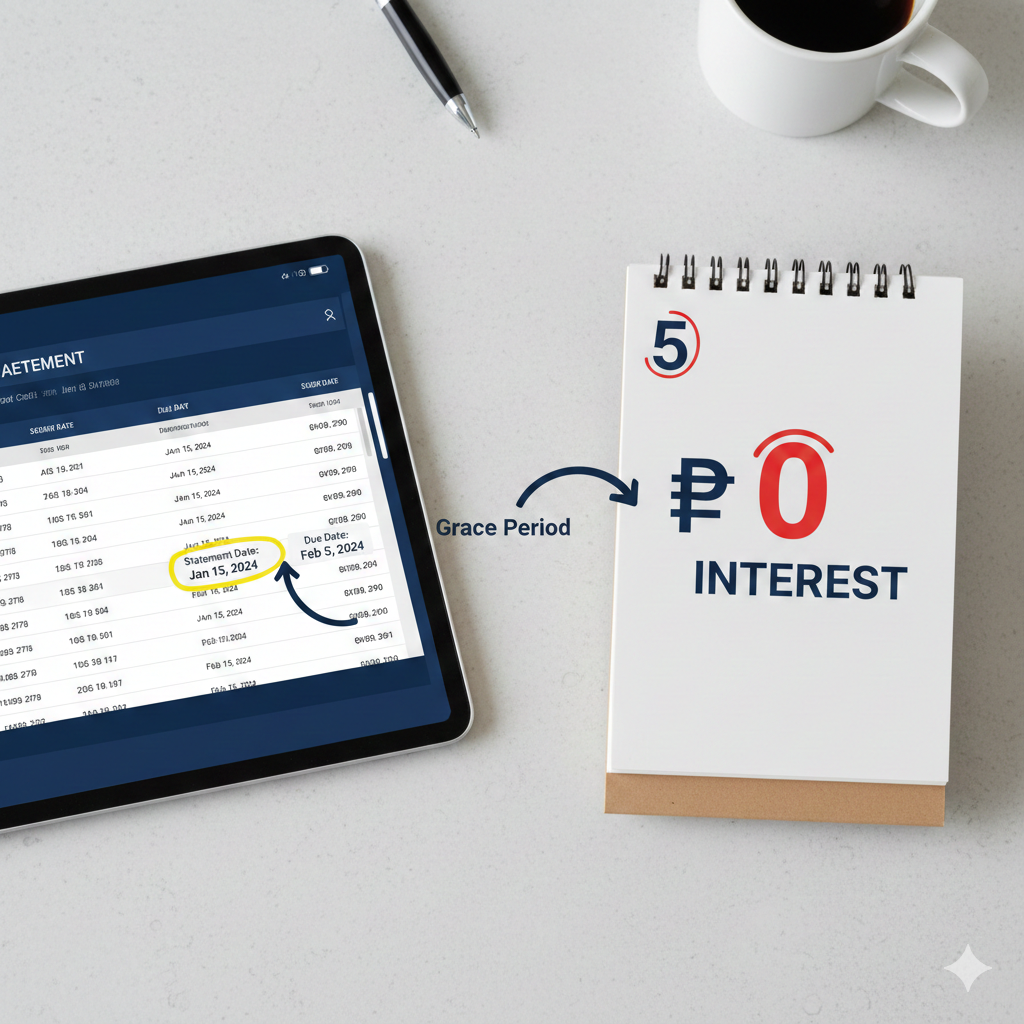
According to the BSP primer, this is how the grace period works. If you pay your total amount due in full on or before the payment due date, you pay zero finance charges. The 20 to 30 days between your purchase and your due date are interest-free.
But if you pay anything less than the full amount, even if it's just ₱100 short, you trigger interest charges. Interest accumulates on the unpaid balance, and according to issuer rules, new purchases may also start accruing interest immediately, losing the grace period benefit.
So the rule is binary. Pay in full, or pay interest. There's no middle ground.
This single rule is what separates people who use credit cards successfully from people who end up in debt.
Trisha has had a credit card for five years. She's never paid a single peso in interest. Not because she's rich. Not because she has perfect self-control. But because she has one inflexible rule: pay the full balance every month.
Some months she uses ₱8,000. Some months ₱15,000. Doesn't matter. She pays whatever the statement says. In full. Every time.
That's it. That's the entire strategy that keeps her stress-free.
Here's how to make this rule automatic:
For a complete explanation of why this matters, read: Credit Card Due Dates Explained.
Here's what I wish someone had told me before I got my first credit card.
You don't need to be brave. You don't need to "get over" your fear. You don't need to fake confidence or pretend you know what you're doing.
You just need clarity.
Once you understand the rules, the fear evaporates naturally. Not because you've conquered it. But because you know exactly what to expect.
Think about learning to drive. At first, it's terrifying. So many things to track. So many rules. So many ways to mess up.
But after you understand how the car works, how traffic rules work, how to check your mirrors and signal and brake, driving stops being scary. It becomes routine.
Credit cards are the same. The fear comes from not knowing the mechanics. Once you know them, it's just a series of simple behaviors.
That's basically it. Those five concepts explain 90% of how credit cards work.
Studies on financial literacy show that when people learn these basic concepts, their financial stress often decreases. Not because they become perfect money managers. But because uncertainty decreases.
You know what to expect. You know what to do. You know the consequences of each choice.
That clarity replaces fear with confidence.
If you already have a credit card but haven't activated it yet because you're scared, here's how to start.
After three months of this, credit cards stop feeling scary. Because you've proven to yourself that you can manage it.
You don't need courage to start. You need a system that makes the right behavior easy.
Kim activated her card but only used it for her internet bill. ₱1,500 per month. Auto-charged. She'd pay it in full the day the statement arrived.
After six months, she expanded to using it for groceries too. But she kept the same rule. Pay in full. Every month.
Now she uses it for almost everything and has never paid interest. Not because she's disciplined. Because she built the habit when stakes were low.
I want to be honest about something.
Sometimes the fear of getting a credit card is trying to tell you something.
If you're currently struggling with cash flow, living paycheck to paycheck, or don't have any emergency savings, the fear might be valid.
Not because you're not capable. But because adding a credit card to an already tight financial situation increases risk.
Credit cards work best when you're financially stable enough to pay in full every month. If you're not there yet, the fear might be your instinct protecting you.
If any of these apply, it's okay to wait. Build stability first. Save an emergency fund. Get your income consistently above your expenses.
Then come back to credit cards when you're ready.
There's no shame in recognizing you're not in the right position yet. That's wisdom, not weakness.
But if your only barrier is fear based on lack of knowledge, that's different. That's fixable.
For broader money management strategies, check out: Smart Money Habits for Young Filipinos.
Here's what nobody tells you about credit cards.
Once the fear disappears and you understand how they work, credit cards become boring. In the best possible way.
You stop thinking about them constantly. You stop worrying about due dates because you have systems. You stop second-guessing every purchase because you know your rules.
It just becomes a routine part of your financial life. Like paying rent or buying groceries. Not exciting. Not scary. Just normal.
That's the goal. Not to become a credit card expert or maximize every reward. But to reach a place where using credit is so well understood that it's boring.
The fear you feel now will seem strange a year from now. You'll wonder why you were so anxious about something so straightforward.
That's not because you'll have changed as a person. It's because you'll understand the rules.
Remember that anxiety I felt when my first credit card arrived?
It lasted about two months. Then it disappeared completely.
Not because I became braver or more confident. But because I learned five simple facts.
Statement date vs due date. Pay in full to avoid interest. Track spending before the bill arrives. Set up payment reminders. Never treat the limit as a target.
That's it. Five concepts. Once I understood those, the fear had nothing to attach to.
The credit card didn't change. I didn't develop superhuman willpower. I just filled in the knowledge gaps that were creating uncertainty.
And uncertainty is what fear actually is. Fear of the unknown. Fear of what might happen. Fear of consequences you don't understand.
Once you know what to expect and what to do, that specific fear disappears.
You don't need courage to use your first credit card. You don't need perfect self-control. You don't need to be special or different from the people who end up in debt.
You need clarity. You need systems. You need to understand five basic concepts and follow one simple rule.
That's manageable. That's doable. That's within reach right now.
The horror stories you've heard happened to people who didn't understand these concepts. Or who understood them but didn't build systems to follow through.
You can be different. Not because you're better. But because you're starting with information they didn't have.
So if you're holding an unactivated credit card right now, or if you're hesitating to apply because you're scared, take a breath.
The fear makes sense. But it's based on what you don't know, not on what's actually going to happen.
Learn the basics. Build simple systems. Start small. Pay in full.
Do that, and a year from now you'll wonder what you were so afraid of.
If you want to learn more about using credit cards responsibly, check out our guides:
I Just Got My First Credit Card - What Should I Do First? | Credit Card Due Dates Explained | How to Use One Credit Card Like a Pro