A Quarterly Savings Check-Up (Without Overthinking It)
A simple quarterly savings check-up helps Filipinos stay on track without stress. This guide explains what to review — and what to ignore.
Confused by credit card due dates? Learn why many Filipinos still get charged interest and how to avoid it permanently.
I still remember my first credit card statement.
I paid ₱8,000 the day after I got my bill. I felt responsible. I felt proud.
Then the next month's statement came. ₱240 in interest charges.
Wait, what? I paid. Didn't I do everything right?
This happens to so many Filipinos. You pay your bill. You think you're being responsible. Then boom, interest charges appear anyway.
The problem isn't that you didn't pay.
The problem is most people don't understand how credit card due dates actually work.
Here's what nobody tells you clearly enough. Credit card interest isn't about whether you paid. It's about when you paid and how much you paid.
Once you understand the timing, interest becomes completely optional.
If you're brand new to credit cards, start with our guide on Personal Finance Basics in the Philippines.
Learn MoreBut if you're already seeing mystery interest charges on your statement, keep reading.
Most people think these mean the same thing.
They don't.
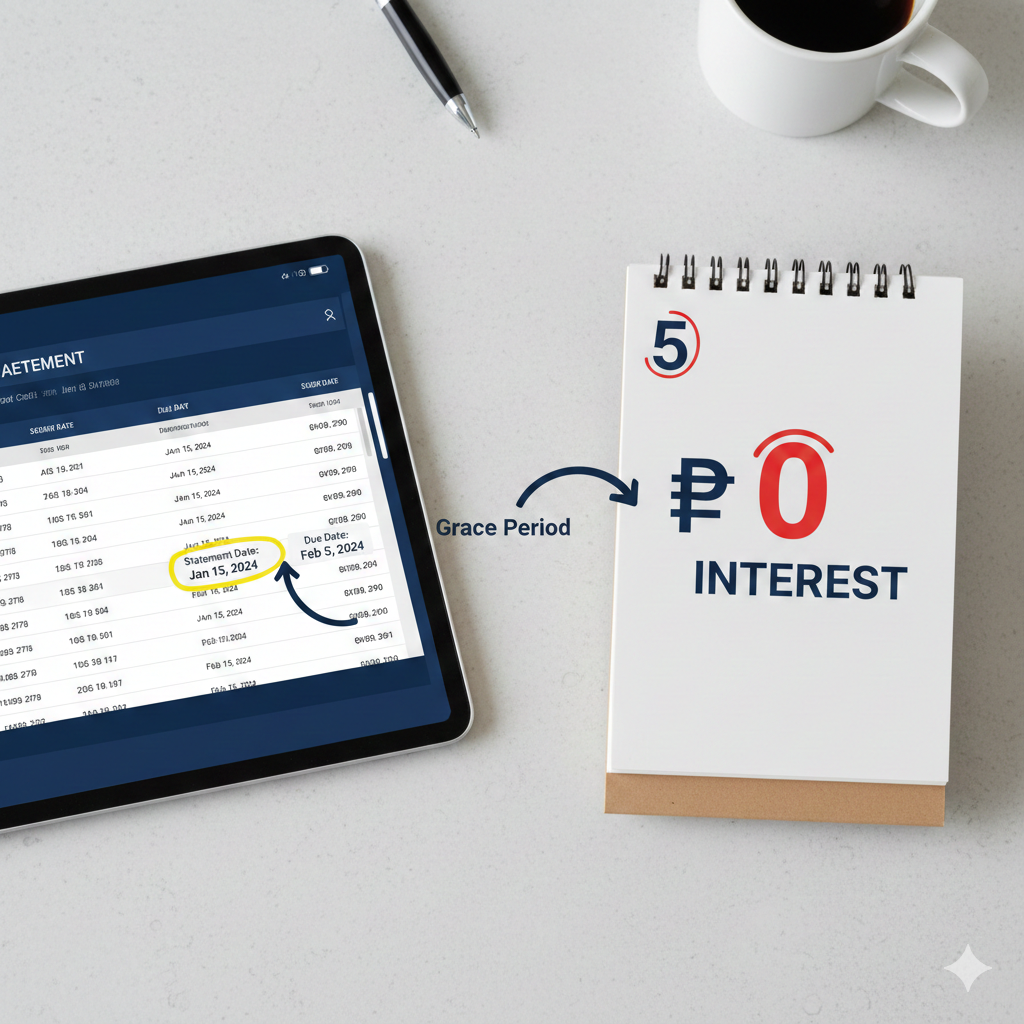
Your statement date (also called cut-off date) is when your bank takes a snapshot of everything you spent that month. It's when they create your bill.
Your due date is the last day you can pay that bill without getting charged interest.
Here's what BPI says in their credit card guide. If you make a purchase after your statement date, it doesn't appear on that bill at all. It rolls over to next month's bill.
The BSP credit card primer is clear about this. You avoid finance charges by paying the total amount due in full on or before the payment due date for that billing cycle.
Not the statement date. The due date.
Under RA 10870 and BSP regulations, your billing cycle has to be at least 15 days long. Most Philippine banks give you somewhere between 20 to 30 days between your statement date and due date, depending on the bank.
This gap is your grace period.
Here's something the BSP explicitly points out. Making big purchases at the start of your statement period maximizes your grace period. If you buy a ₱50,000 laptop right after your statement date closes, you get almost two months before you need to pay for it.
That's almost two months of free credit.
Let me walk you through this step by step.
Your statement date is the 15th of every month. Your due date is the 5th of the following month.
The BSP's 2020 circular on credit card interest is crystal clear. Interest is computed on the unpaid outstanding balance as of the statement date.
So if you owe ₱20,000 and you only pay ₱18,000 before the due date, you get charged interest on that remaining ₱2,000.
Not just that. You also lose your grace period on new purchases.
This is the trap most people fall into without realizing it.
The simplest rule in personal finance: Pay your full statement balance every month.
Not the minimum. Not "most of it." The full amount shown on your statement.
The BSP sets a regulatory ceiling on credit card finance charges at 3% per month. That works out to roughly 36% per year on revolving balances.
But here's the beautiful part.
Pay your balance in full on or before the due date, and according to the BSP primer, you pay exactly zero pesos in finance charges.
The BSP states this explicitly. You only enjoy the full benefit of the grace period if there is no unpaid balance from the previous billing cycle.
Translation: if you carried any balance from last month, you lose the grace period on this month's purchases too.
This is the rule that changed everything for me.
Once I committed to paying in full every single month, my credit card became a tool instead of a trap. I get rewards. I track my spending. And I never see an interest charge.
Let me show you something that will probably make you angry.
Most Philippine credit cards set the minimum due at around 3% to 5% of your outstanding balance, or a fixed peso amount like ₱500 to ₱1,000, whichever is higher.
Sounds reasonable, right? You can "afford" ₱500 a month.
Here's what actually happens.
This is standard revolving credit behavior. Philippine legal commentaries on credit card debt note that minimum-only payments can stretch debt repayment for years, with most of each payment going to interest rather than principal.
Here's what minimum payments actually cost you:
For a deeper dive into this trap, check out Paying the Minimum vs Paying in Full.
This is where things get tricky.
When you don't pay your previous month's balance in full, interest starts accumulating on the unpaid balance from the statement date.
Even if you pay your current balance in full before the due date, you may still see interest charges from that earlier partial payment.
The BSP's guidance shows how interest is computed on the unpaid outstanding balance as of the statement date.
This is also why payment posting dates matter.
BSP rules state that banks should credit payments according to their posted cut-off times across accredited payment channels. But in practice, third-party channels like 7-Eleven, GCash, or Maya sometimes take 1 to 2 days to process.
The grace period is your best friend.
It's the time between when you make a purchase and when you actually have to pay for it, without any interest charges.
The BSP primer explains it clearly. You avoid finance charges by paying the total amount due on or before the payment due date. And you only get this benefit if there's no unpaid balance from the previous cycle.
If you're carrying any debt, even ₱100, you lose the grace period on all new purchases. They start accumulating interest from day one.
This is why paying in full every month is so critical.
The moment you carry a balance, everything changes. Your credit card stops being a convenient payment tool and becomes an expensive loan at roughly 36% annual interest.
Okay, so you understand the rules now.
Let's talk about execution.
Here's what works:
Under RA 10870 regulations, you have up to 30 days to dispute billing errors. So you still need to review your statements even with auto-pay.
Treat your due date like rent. This is the mindset shift that matters most. You wouldn't skip rent because "it's tight this month," right? Same with your credit card.
The due date is not a suggestion. It's a financial obligation you committed to when you used the card.
Here's what you can expect:
Miss your payment, and the penalties stack up fast.
If you ever do miss a payment, here's what to do immediately:
Pay at least the minimum to stop additional late fees. Then pay as much as you can above the minimum. Call your bank and explain the situation, especially if it's your first time. Some banks waive the late fee for first-time offenders. Then commit to paying the full balance as soon as possible to minimize interest damage.
After all this, the real reason most Filipinos pay credit card interest isn't because they don't understand the rules.
It's because they use credit cards as emergency funds or spending money they don't actually have.
I see this pattern everywhere.
Someone gets their first credit card with a ₱20,000 limit. Within three months, they're at ₱18,000 balance from Shopee budol, Lazada flash sales, and "needed" purchases that weren't really needs.
They pay the minimum because that's all they can afford.
Then they're stuck.
Credit cards are not extra money. They're a payment method.
The golden rule is simple. Never charge anything to your credit card that you can't pay off in full by the due date.
If you can't afford to pay cash for it today, you can't afford to put it on credit.
The only exception should be genuine emergencies. And even then, you need a plan to pay it off within 2 to 3 months max.
The entire credit card business model is built on people carrying balances and paying interest.
Don't let them win.
For more strategies on responsible credit card use, check out our guide for Credit Cards for Beginners in the Philippines.
Credit Cards for BeginnersOnce you've mastered paying in full every month, here are some next-level strategies.
Remember that ₱240 interest charge I mentioned at the beginning?
It came from carrying a balance for one month because I didn't understand the difference between statement date and due date.
I thought paying after I got the bill was good enough.
I was wrong.
Once I learned the real rules, my entire approach changed.
I started paying in full every month. No exceptions.
I haven't paid a single peso in interest in over three years now.
The rules are actually simple.
Know your statement date and due date. Pay the full statement balance before the due date. Never carry a balance month to month. Never pay just the minimum. Set up reminders so you never forget.
That's it.
Follow these rules and you'll never pay interest.
Your credit card becomes a powerful financial tool that gives you rewards, builds your credit score, and provides convenient payment options, all at zero cost.
Understand your due dates. Master your billing cycle. Pay in full every time.
Your future self will thank you.

A simple quarterly savings check-up helps Filipinos stay on track without stress. This guide explains what to review — and what to ignore.

When savings finally feel sufficient, many Filipinos feel uncertain instead of relieved. This article explains what "enough" really means...
Locking money sounds restrictive — but for some Filipinos, it reduces stress. This article explains when restricted access can actually improve p...