A Quarterly Savings Check-Up (Without Overthinking It)
A simple quarterly savings check-up helps Filipinos stay on track without stress. This guide explains what to review — and what to ignore.
Just got your first credit card? Learn exactly what Filipinos should do first to avoid debt, build credit, and stay in control.
Exciting, Yes. But Also Easy to Mess Up.
One of the most common posts on r/PHCreditCards starts like this:
"I just got approved for my first credit card. Any tips?"
That question matters more than people realize.
Your first few months with a credit card shape your habits for years. And in the Philippines, where stories of credit card debt horror are practically folklore, getting it right from day one is crucial.
I still remember my first card approval. BPI sent me a text at 2 PM on a random Tuesday. I screenshotted it. Sent it to our family group chat.
My tita replied: "Congrats! Don't be like your Kuya, he's still paying off 2019."
That was my wake-up call before I even activated the card.
This guide is for Filipino first-time cardholders who want confidence, not fear. Control, not confusion. And a system that actually works.
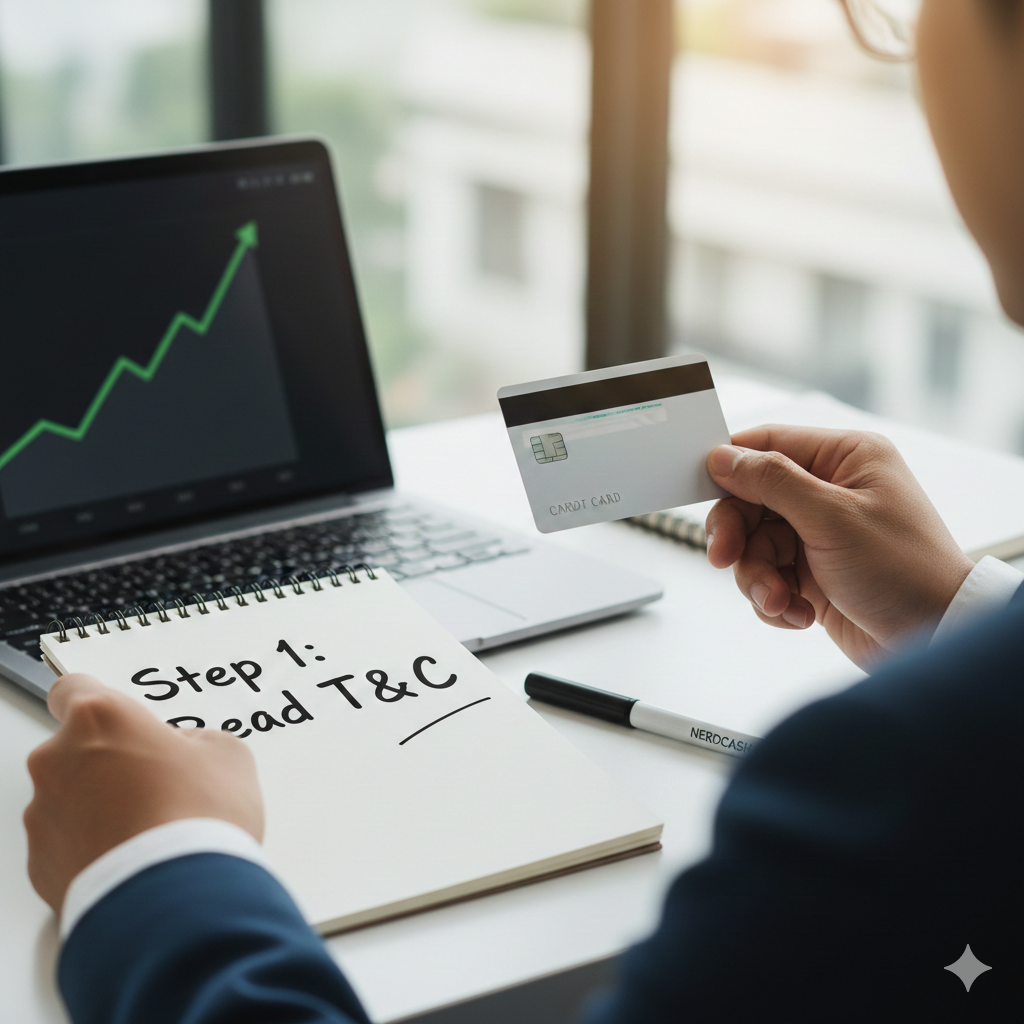
I know, nobody wants to read 20 pages of legal text.
But here's the thing. Your card's T&Cs tell you exactly how much things cost when you mess up.
A friend once got charged ₱3,500 for a "cash advance fee" after topping up her GCash. She had no idea wallet reloads could count as cash advances. It was buried on page 12 of the terms she never opened.
According to BSP regulations, all credit card issuers must clearly disclose annual fees, interest rates (currently capped at up to around 36% per year, depending on the latest circular), late payment penalties, cash advance fees, and foreign transaction charges.
The BSP also requires banks to explain these in plain language in a prominent table.
Spend 10 minutes skimming through. Look for what triggers a fee, how interest compounds, and what counts as a "cash advance."
Here's what to look for specifically. Some banks treat certain wallet or quasi-cash transactions as cash advances, so check your T&Cs to be sure.
Before swiping even once, find your statement date (when your bill is generated) and your due date (when payment is required).
Everything charged before the statement date appears on your bill. Everything unpaid after the due date earns interest. And in the Philippines, that interest compounds fast.
If this is confusing, read this before anything else: Credit Card Due Dates Explained.
Your monthly bill will show two numbers. Total amount due and minimum amount due.
According to MoneyMax and bank disclosures, the minimum is usually around 3% to 5% of your balance or ₱400 to ₱500, whichever is higher.
Here's what many first-time users don't realize. Paying only the minimum keeps you in debt longer and costs you way more.
Here's what minimum payments actually cost you:
The rule: Always pay in full. If you can't, you're spending beyond your means.
For a deeper dive into why this matters, check out: Paying the Minimum vs Paying in Full.
The safest beginner rule: only charge what you already have cash for.
Think of it this way. If you can't pay for it in cash today, don't swipe.
Good first-card expenses:
Avoid emotional or impulse spending early on. No "sale lang" budol sessions at Shopee at 11 PM. Do not buy shoes just because there's a 0% installment promo.
A finance influencer I follow has a 24-hour rule for any purchase she wants. This is a good pause and a way to be intentional with your spending.
Think of your credit card as a convenience tool, not extra money. It's a payment method, not a loan you asked for.
Many beginners fall into this trap: "At least I earned points."
Rewards don't matter if they make you spend more, justify unnecessary purchases, or distract you from paying in full.
You'll learn rewards later. Discipline comes first.
Local banks love promoting 0% installment promos and "buy now, pay later" schemes. They're designed to encourage spending. Fintechs promote cashback as free money.
Here's the truth. You don't "save" money by spending it.
A marketing professional I know admitted: "I justified buying a new phone on installment because 'walang interest.' But I wouldn't have bought it at all if I had to pay cash. That's not savings, that's spending I tricked myself into."
Master paying in full for at least 3 to 6 months before you start optimizing for rewards.
Cash advance is one of the fastest ways to get into debt.
Why?
BSP regulations now cap cash advance processing fees at typically ₱200 per transaction. But you also get charged high interest with no grace period, and you earn no rewards.
Plus it signals financial trouble to banks and can hurt future applications.
If you need cash often, that's a savings problem, not a credit card solution.
What can count as cash advance in the Philippines:
BSP security guidelines for cardholders include:
Fraud is real. Local scammers are creative.
Common scams to watch out for:
A teacher from Quezon City shared her story online. Someone used her card for ₱23,000 in online purchases. She didn't notice for 3 weeks because she doesn't check her email. Bank said too late to dispute. She paid the full amount.
Your bank won't always automatically refund unauthorized charges. You'll need to prove you didn't consent. And under RA 10870 and bank policies, you usually have only 30 to 60 days to report it, depending on your bank's specific dispute window.
Before your first bill, set up your system.
Enable app notifications. Add calendar reminders (set 2: one week before, one day before). And consider auto-pay only if you're disciplined enough to track your spending.
Systems prevent mistakes better than memory.
I use Google Calendar with SMS reminders. Two notifications. Seven days before so I can transfer funds if needed. One day before as a last call to pay.
Missing even one payment can trigger late fees (typically in the range of ₱500 to ₱1,500 depending on the bank), hurt your credit score, and make future loan applications harder.
Banks share payment data with credit bureaus. One missed payment at 23 can haunt you when you apply for a car loan at 28.
Local legal commentaries confirm that missed payments and delinquencies are reported to Philippine credit bureaus and can affect future loans and approvals.
You don't need multiple cards to "build credit."
One card, paid in full for 6 to 12 months, already does that.
The BSP's credit card primer literally advises maintaining only the right number of cards because multiple cards mean more due dates and more monitoring.
I know someone who got three cards in his first year. Different due dates (5th, 18th, 25th). Different reward systems. Different promos.
He missed two payments, maxed one card, and spent a year cleaning up the mess.
Focus on mastering one card first. Different due dates, different promos, different limits. That's advanced territory.
Your monthly statement is a free financial audit.
Review every transaction. Spot fraudulent charges early. Check for interest and fees. Did you trigger any by accident? Look at your spending patterns. Are you creeping toward your limit?
If you see charges you don't recognize, dispute them immediately.
Under RA 10870 (Credit Card Industry Regulation Law), you have rights as a cardholder. But only if you report issues within the bank's dispute window, which banks commonly set at 30 or 60 days from statement date in their terms and conditions.
Set a recurring calendar event: "Review credit card statement." First Saturday of every month. Ten minutes. That's it.
From actual r/PHCreditCards discussions:
Your first credit card is a training tool.
Master it, and everything else becomes easier.
The horror stories you've heard usually start with one of these mistakes. Treating credit like free money. Paying only the minimum. Ignoring statements. Applying for multiple cards too fast. Or justifying spending because of rewards.
You're already ahead by reading this.
Now just stick to the basics.
Do that for six months, and you'll have built a habit most Filipinos never develop. Control over credit, instead of the other way around.
Your Kuya who's still paying off 2019? You won't be him.
If you're ready to level up, check out our full guide:
Credit Cards for Beginners in the Philippines
A simple quarterly savings check-up helps Filipinos stay on track without stress. This guide explains what to review — and what to ignore.

When savings finally feel sufficient, many Filipinos feel uncertain instead of relieved. This article explains what "enough" really means...
Locking money sounds restrictive — but for some Filipinos, it reduces stress. This article explains when restricted access can actually improve p...