How Credit Card Travel Points Actually Work in the Philippines
Confused about travel points? This beginner-friendly guide explains how credit card travel points actually work in the Philippines — without hype or shortcuts.
"Am I Ready for a Travel Card?"
It usually starts with a post on r/PHCreditCards.
"I've had my cashback card for six months and I've been good about paying in full. Should I upgrade to a travel card?"
The replies are always split. Half the thread says go for it. The other half says wait. And the person asking ends up more confused than when they started.
This question shows up at a very specific moment: a few months into smooth card usage, growing curiosity about miles, and exposure to enough premium card marketing that cashback starts to feel a little boring.
That last part is worth pausing on.
Because the feeling that you're missing out — na may mas maganda pa — is usually the worst reason to upgrade. And it's the reason most people actually do it.
This article helps you decide based on readiness, not hype.
If you're new to travel rewards and want to understand the basics first: 👉 Credit Card Travel Rewards in the Philippines: A Beginner's Guide
Nobody posts on forums about how great their cashback card is.
You don't see Instagram reels about earning 2% back on groceries. There's no community of Filipinos tracking their cashback balances and celebrating when they hit ₱500 in credits.
But miles? There are entire subreddits, Facebook groups, and YouTube channels dedicated to the hobby.
So cashback feels small. Boring. Like the beginner tier you're supposed to graduate from.
The thing is — boring is doing a lot of work for you.
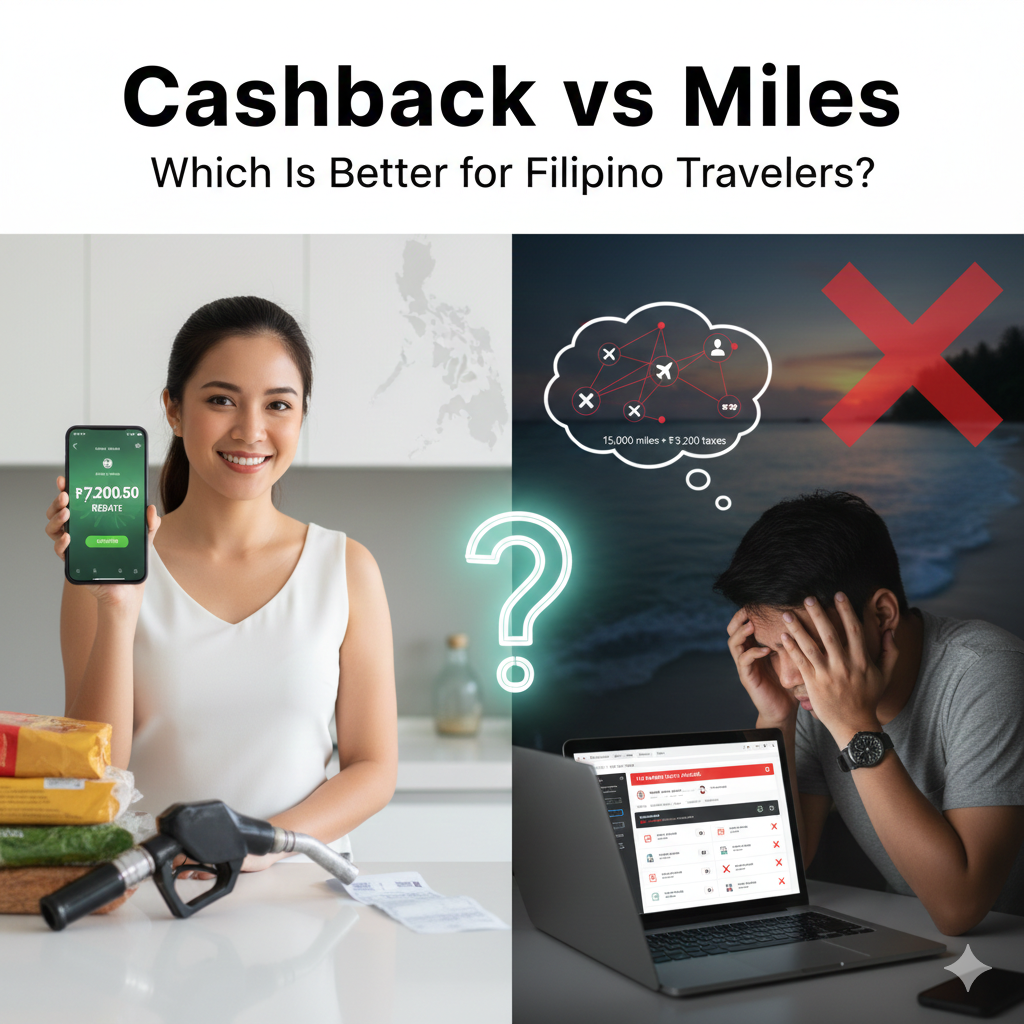
Cashback is predictable. Every peso you spend returns a fixed percentage, no conversions needed, no expiry dates, no redemption planning. It shows up as a statement credit and reduces your next bill. The math is simple and the value is guaranteed.
Si Mikee, a 29-year-old from Pasig, spent three years on a flat-rate cashback card before switching to a travel card. "Parang wala akong ginagawa," she said. "But when I actually added it up, I had earned about ₱8,000 in cashback credits over those years without thinking about it once."
That ₱8,000 came from doing nothing special. No optimization, no category tracking, no promo-chasing. Just consistent spending and full payments every month.
Many people upgrade before they've finished earning what their cashback card was already giving them quietly.
Switching to a travel card isn't just a perk upgrade. It's a system change.
With cashback, the loop is short: spend, earn a percentage, see it on your bill.
With a travel card, the loop is longer: spend, accumulate points or miles, understand conversion ratios, check airline partner options, find award availability, plan travel dates around seat release windows, submit a redemption request, wait for processing, then book.
That's not a criticism of travel cards. For the right person, that longer loop is worth it. But beginners often switch to travel cards picturing the cashback loop — simple, automatic, no effort — and are surprised when the miles system requires more from them.
The annual fee goes up. The rules get more complex. Conversion requirements appear that didn't exist before. Redemption planning becomes something you actually have to do rather than something that happens automatically.
Dami palang steps, is the most common reaction from first-time travel card users who upgraded too early.
There's no universal checklist, but these are strong indicators that upgrading makes sense.
Even if all four are true, there's no urgency. Being ready doesn't mean you have to upgrade immediately.
These are harder to admit — but more important to be honest about.
👉 Are Travel Credit Cards Worth It If You Only Travel Once a Year?
Every upgrade conversation eventually hits this number.
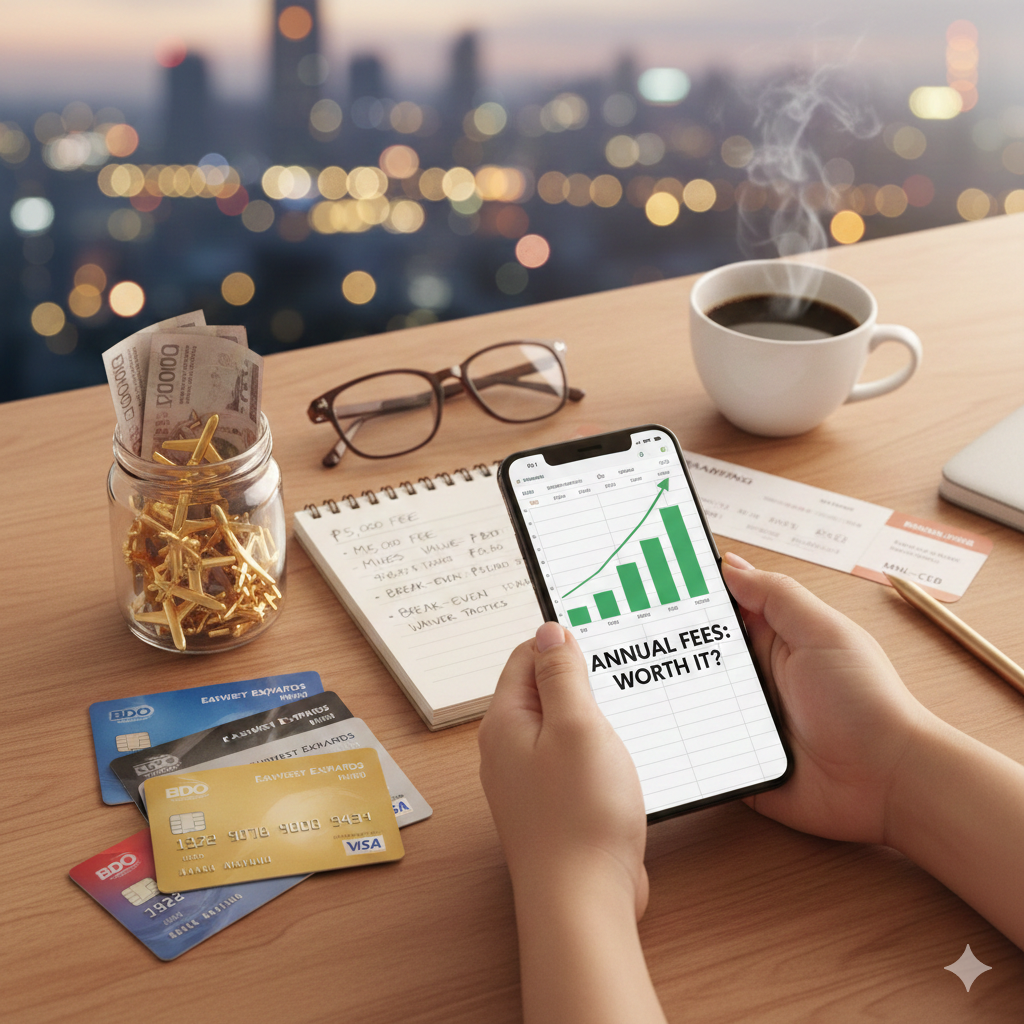
Travel cards carry annual fees of ₱4,000 to ₱6,000. Cashback cards are often free, or close to it.
The question to ask honestly: Will I earn more in miles value than the fee costs — without changing my behavior?
Without changing behavior is the key phrase. Upgrading to a travel card and then spending more to justify it is how people end up worse off. The fee has to make sense based on what you were already spending before the upgrade.
At ₱30,000 a month on a ₱30/mile card, you earn 12,000 miles a year — worth roughly ₱9,600 at ₱0.80 per mile. Against a ₱4,000 annual fee, that's a net positive of ₱5,600. The math works.
At ₱10,000 a month, you earn 4,000 miles a year — worth roughly ₱3,200. Against a ₱6,000 annual fee, you're losing ₱2,800 annually. Hindi sulit.
Run your own numbers before upgrading. Not the marketing materials' numbers. Yours.
👉 Annual Fees on Travel Cards: When Are They Actually Worth Paying?
Here's the honest version of why most people actually upgrade.
The card looks premium. The metal feels heavier. The name sounds like an achievement.
There's nothing wrong with enjoying those things — but they're not a financial argument. And they're exactly what card marketing is designed to make you feel.
Si Paolo, a 33-year-old from Alabang, upgraded to a Chinabank Destinations World after getting a promotion at work. "It felt like the right next step," he said. "Like I'd leveled up." He used the card for eight months before sitting down to calculate whether it was actually working for him. It wasn't — his spending was mostly local and under ₱15,000 a month. The miles he earned were worth less than the annual fee.
Financial progress doesn't look like a heavier card. It looks like less stress, more control, and fewer surprises on your monthly bill. A well-used cashback card can deliver all three of those things in a way a poorly-timed travel card upgrade cannot.
Prestige is a feeling. Value is a number. Gawin mong panalo ang numero.
For most Filipinos, the sequence that works best looks like this.
This path takes longer. It produces far less regret.
Miles will still exist next year. The airline programs aren't going anywhere. The cards will still be available when you're ready.
What changes when you upgrade before you're ready is that the complexity works against you instead of for you. You pay fees for a system you're not using effectively. You carry the mental load of a rewards program you don't fully understand. You feel the pressure to spend more to justify the upgrade.
Waiting costs you nothing. Upgrading too early costs you the annual fee, the interest if anything goes wrong, and the stress of a system you didn't need yet.
Ang clarity beats urgency. Every time.
There is no rule that says owning a travel card is better than owning a cashback card. There is no financial milestone that requires you to switch.
The best card is the one that fits your current life — your actual spending, your actual travel habits, your actual tolerance for complexity. For some people, that's a travel card. For plenty of others, it's the cashback card they already have.
Upgrade when it genuinely makes your financial life easier. Not when it looks like progress. Not because a promo is running. Not because your friend just got the Chinabank Destinations World and it looks amazing in photos.
When the math works and the timing is right, upgrading will feel obvious — hindi kailangang pilitin.
👉 Cashback vs. Miles: Which Is Better for Filipino Travelers?