Why Most Filipinos Struggle to Save (And It's Not Discipline)
Struggling to save doesn't mean you're bad with money. Why discipline is rarely the real issue.
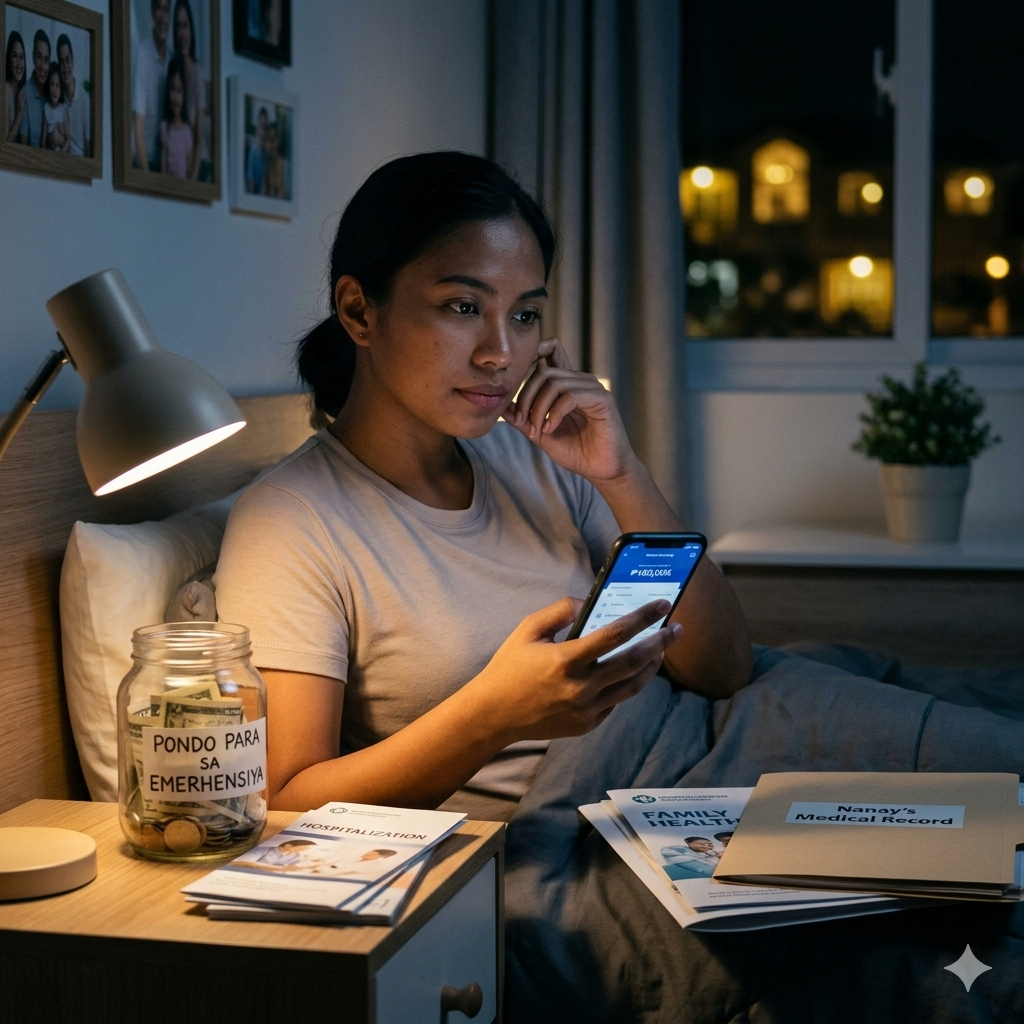
Ito yung hindi madalas pinag-uusapan.
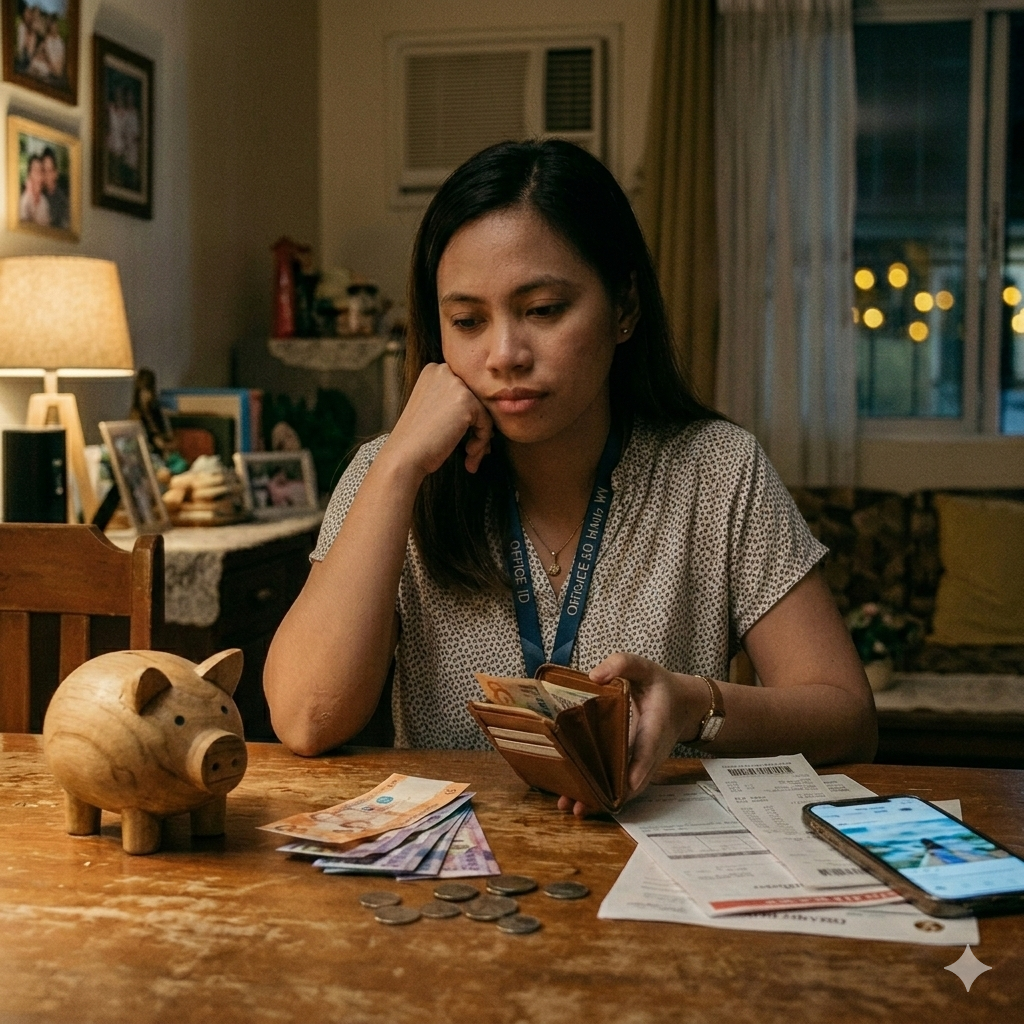
Meet Karen. She's 29, works as a senior analyst at a consulting firm in BGC, and earns ₱65,000 a month. By most standards, she's doing well. She has ₱180,000 in her savings account — more than a lot of her friends. She maxes out her SSS and Pag-IBIG contributions. She even started a small UITF investment last year.
On paper, Karen should feel proud. She should feel calm.
But every Sunday night, she lies awake doing mental math. What if I get sick? What if my mom needs surgery again? What if I lose my job? She checks her bank balance almost daily — not out of excitement, but out of anxiety. The number is there. The peace of mind isn't.
If this sounds familiar, you're not alone. And you're definitely not broken.
According to an AIA Philippines study, nearly 60% of Filipinos consider money their top source of stress — even among those who have savings. Two in five Filipinos feel that their savings and insurance are not enough to cover unexpected incidents, especially health emergencies.
This creates a strange situation: you can have money saved and still not feel secure. And when that happens, most people assume something is wrong with them. That they should be grateful. That they're being irrational.
But it's not irrational. There's a real difference between saving money and feeling secure — and understanding that difference can help you stop beating yourself up.
If saving anything at all already feels hard, you might want to start here: 👉 Why Most Filipinos Struggle to Save (And It's Not Discipline)
Let's start with a simple distinction that changes everything.
Saving money is a behavior. It's something you do. It's measurable — you can look at your bank account and see a number. It's objective — ₱50,000 is ₱50,000, regardless of how you feel about it. It's visible — you can track it, chart it, compare it.
Feeling secure is something else entirely. It's emotional. It's context-dependent. It's shaped by your past experiences, your current circumstances, and your fears about the future.
One does not automatically create the other.
You can save diligently for years and still feel anxious because your job feels unstable. You can hit every financial milestone and still panic because you grew up watching your parents struggle with money. You can have six months of expenses saved and still feel like it's not enough because you know how quickly a hospital bill can wipe that out.
The number in your account is real. But the feeling of security? That's determined by a lot more than just the number.
Here's something that might seem counterintuitive: some people feel genuinely calm even with relatively small savings.
How is that possible?
Usually, it's because other factors in their life create a sense of stability.
Security, for these people, comes from confidence in continuity — not just from a specific peso amount.
This doesn't mean they're doing anything wrong or that savings don't matter. It means that security is about more than just what's in your account.
On the flip side, some people have what looks like "enough" savings — and still feel deeply anxious.
This isn't weakness. It's usually a reflection of their actual circumstances.
Take Joy. She's 32, a team lead at a BPO company in Ortigas, earning ₱48,000 a month. She has ₱120,000 saved — technically more than three months of expenses. Her friends tell her she's "doing great."
But here's what her friends don't see:
Every month, Joy sends ₱12,000 to her parents in Bulacan. Her dad had a stroke two years ago and can't work anymore. Her mom takes care of him full-time. Joy also pays half of her younger brother's college tuition — that's another ₱8,000 per semester, plus allowance. And her company just announced they're "restructuring," which everyone knows might mean layoffs.
So yes, Joy has ₱120,000. But she also has open-ended obligations that could drain that money in weeks. She doesn't know how much she'll need to send home next year. She doesn't know if her job will still exist in six months. The savings are real. The security isn't.
Their income feels fragile. Maybe they're a freelancer with unpredictable projects. Maybe they're on a contractual job that could end anytime. Maybe their industry has been laying people off. When you can't trust that money will keep coming in, no amount saved ever feels like enough.
Past emergencies were traumatic. If you've experienced a financial crisis before — losing a job, watching a parent get sick, going into debt — that experience stays with you. Your nervous system remembers. Even when your current situation is stable, part of you is always waiting for the next disaster.
Family obligations feel open-ended. In Filipino families, financial responsibilities often don't have clear boundaries. You might be supporting parents, siblings, nephews, nieces — with no end date in sight. When you don't know how much you'll need to give next year or the year after, it's hard to feel secure no matter how much you save.
A Sun Life survey found that while 66% of Filipinos feel financially secure in the short term, one in three say they couldn't last more than three months without external support if they lost income or fell ill. That gap — between "I'm okay right now" and "I could survive a crisis" — is where anxiety lives.
👉 Why Your Savings Keep Getting Used (And How to Fix It)
Here's the deeper truth: security isn't really about money. It's about uncertainty.
Money helps reduce uncertainty. But it can't eliminate it entirely. And when the sources of uncertainty are large enough, no realistic amount of savings can make you feel completely safe.
Savings help. But they don't eliminate uncertainty on their own. And pretending they do only makes you feel worse when anxiety persists.
Let's talk about something that quietly destroys a lot of people's peace of mind: comparison.
You see someone on social media celebrating their ₱1 million savings at 28. You see a friend talking confidently about their investments. You see posts about "financial freedom" and "building wealth" that make your own situation feel pathetic by comparison.
And suddenly, your ₱80,000 emergency fund — which was perfectly reasonable five minutes ago — feels like nothing.
This is the trap of social comparison. It shifts your focus from function to status.
Instead of asking "Can my savings protect me from realistic emergencies?" you start asking "Is my savings impressive compared to other people?" These are completely different questions — and the second one will never give you peace.
Here's what those comparison posts rarely show: the person's income. Their family situation. Whether they live rent-free with their parents. Whether they have any dependents. Whether they inherited money or got a windfall. The starting point that made their milestone possible.
Comparing your savings to someone with completely different circumstances isn't just unfair — it's actively harmful to your mental health.
👉 How Much Savings Should You Actually Have in Your 20s and 30s?
If security isn't just about how much you save, what actually creates it?
Systems.
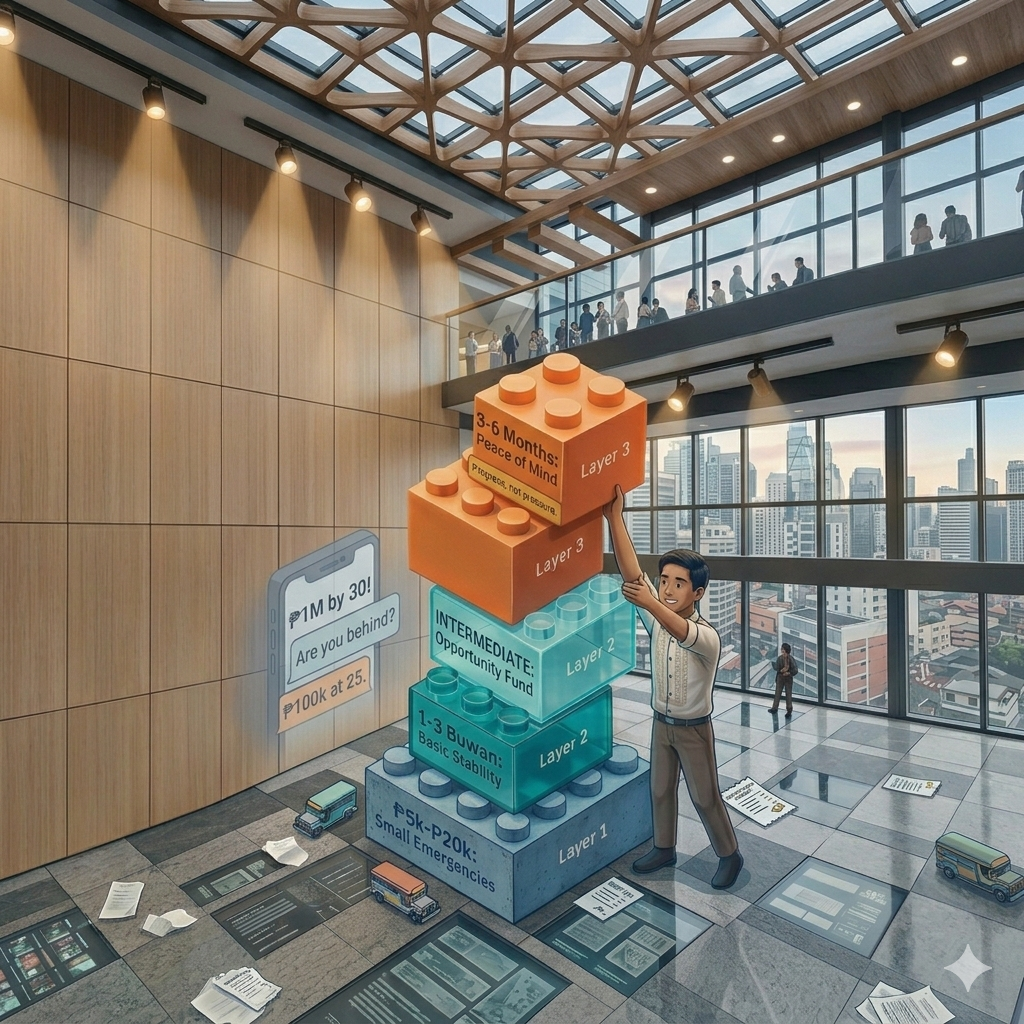
Not a single magic number, but a structure that helps you feel prepared for different scenarios.
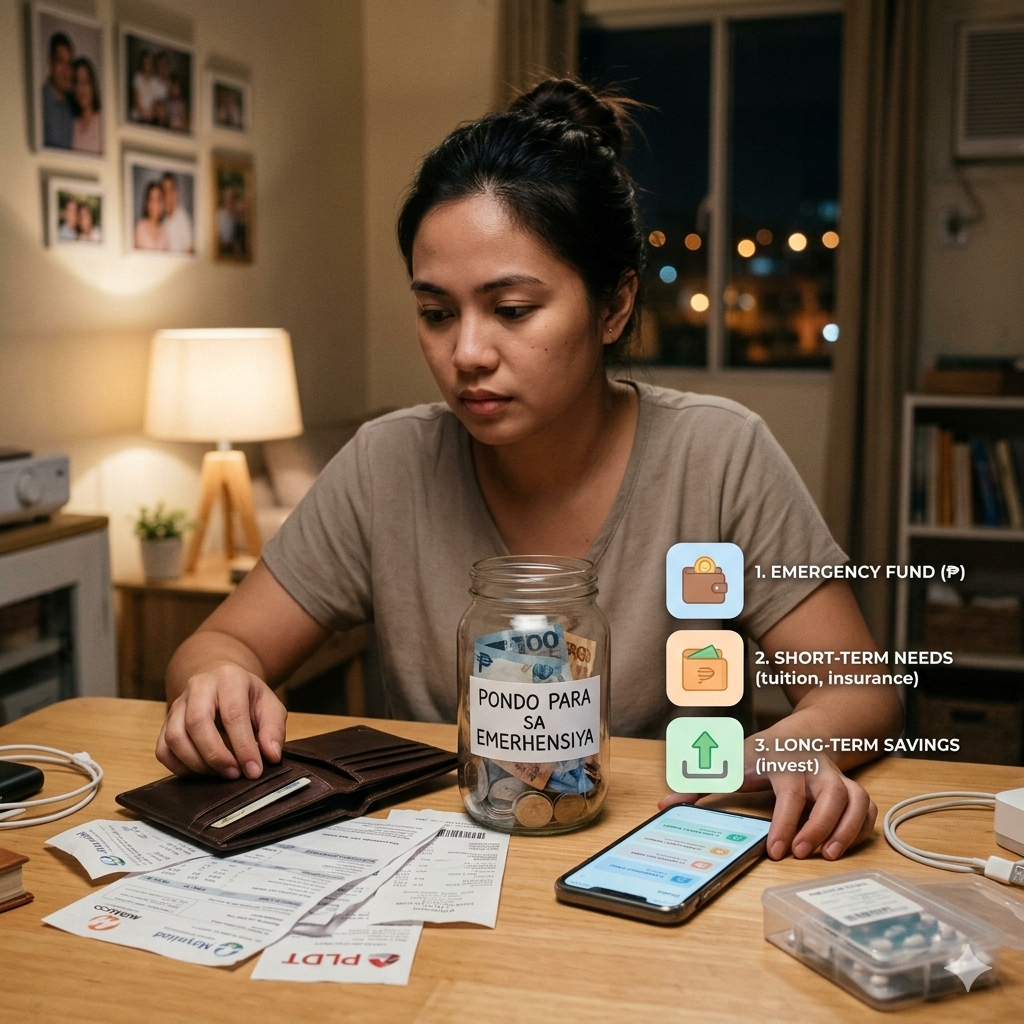
Emergency buffers. Having money specifically set aside for emergencies — and knowing it's there, untouched, waiting if you need it — provides a different kind of calm than just having a high bank balance. It's the knowledge that "if something goes wrong, I have a plan."
Separate accounts by purpose. When your emergency fund, short-term savings, and long-term goals are in different places, you can see clearly what's protected and what's available. This clarity reduces anxiety. You're not constantly wondering "Can I touch this money or not?"
Clear rules for using savings. Knowing when it's okay to withdraw — and when it's not — removes decision fatigue. You're not agonizing over every expense. You have a system that tells you what to do.
Insurance and protection. Sometimes the most security-building move isn't saving more — it's getting coverage for risks that savings alone can't handle. Health insurance, life insurance, income protection. These fill gaps that no reasonable emergency fund can cover.
Systems reduce the mental load of managing money. And when the mental load decreases, anxiety decreases too — even if your total savings stay the same.
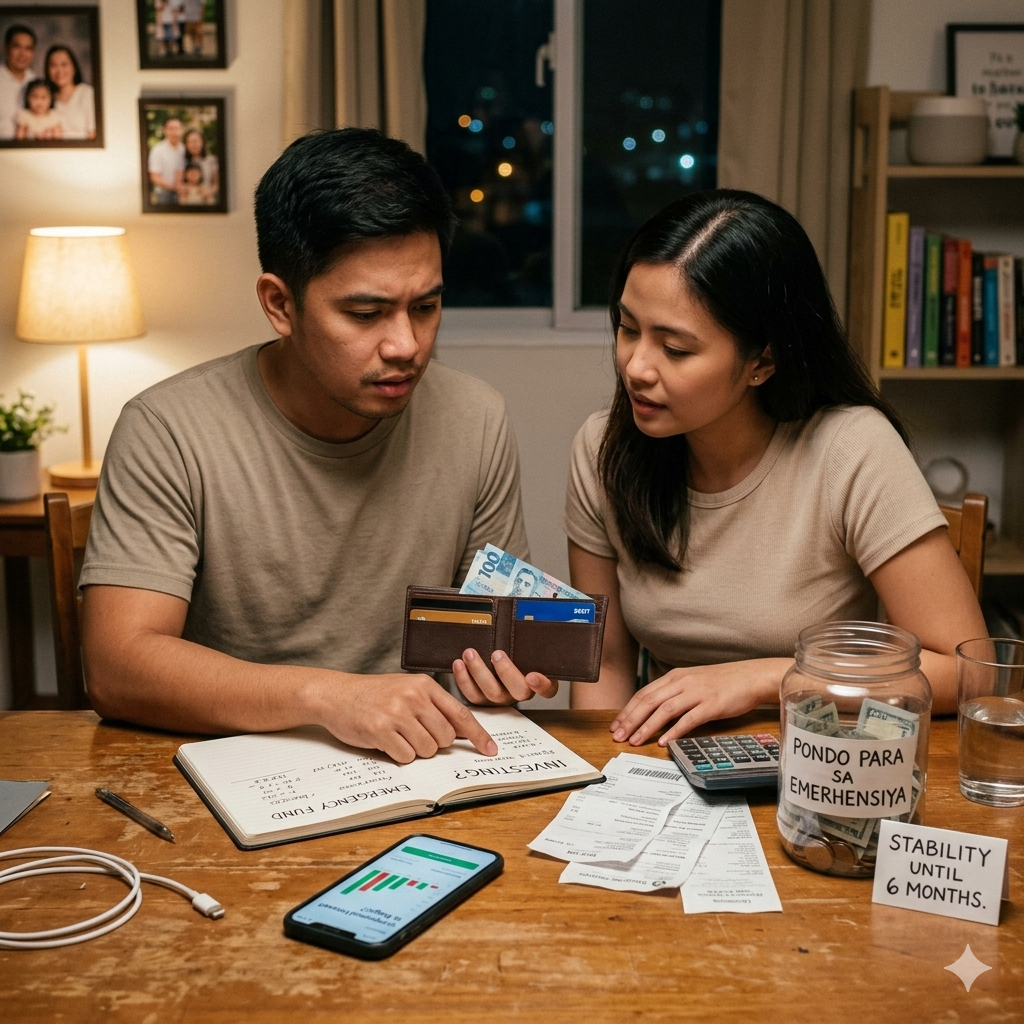
👉 Emergency Fund First or Investing First? (A Filipino Reality Check)
Here's a belief that traps a lot of people:
"Once I save ₱100,000, I'll finally relax." "Once I hit ₱500,000, I'll feel secure." "Once I have a million, I'll stop worrying."
It sounds logical. But it almost never works that way.
What usually happens is this: you hit the number, feel good for maybe a week, and then start worrying about the next milestone. Or you realize that the number wasn't actually enough for the scenarios you're worried about. Or new concerns emerge that the old number doesn't address.
Security doesn't arrive suddenly when you cross a threshold. It grows gradually as uncertainty decreases.
That's why systems matter more than targets. A person with ₱50,000 saved, good health insurance, stable income, and clear financial boundaries with family might feel more secure than someone with ₱500,000 saved but no insurance, unstable work, and open-ended family obligations.
The goal isn't to hit a number and finally relax. The goal is to build a life where relaxation becomes possible — piece by piece, system by system.
So if raw amounts aren't the answer, what should you focus on instead?
These are signs of genuine progress. They matter more than hitting an arbitrary milestone that someone on the internet told you to aim for.
Here's a simple way to assess whether your sense of security is growing, regardless of what your bank balance says.
If you can answer yes to even one or two of these, your security is growing. The number in your account is just one piece of the picture.
Sometimes, you do everything right. You have systems. You have savings. You have coverage. And you still feel anxious.
If that's you, there's something important to understand: the anxiety might not be purely financial.
Marco is 34. He earns well — over ₱100,000 a month as a senior developer. He has nearly ₱800,000 in savings and investments combined. He owns a small condo. By any objective measure, he's financially stable.
But Marco grew up poor. Like, piso-piso sa baon poor. His parents fought about money constantly. He remembers the electricity getting cut off twice when he was in high school. He remembers his mom crying because she couldn't afford his school supplies.
Now, even with ₱800,000 in the bank, Marco still feels that old fear. He checks his accounts obsessively. He feels guilty buying anything nice for himself. A part of him is always waiting for everything to collapse — because that's what money felt like when he was young.
Past experiences shape how we feel about money. If you grew up in a household where money was a source of constant stress, your nervous system learned to associate money with danger. If you've been through a financial crisis — job loss, medical emergency, going into debt — that trauma leaves traces.
These aren't things a bank balance can fix. You can have all the savings in the world and still carry anxiety from experiences that happened years ago.
This doesn't mean you're broken or that you'll never feel secure. It means that sometimes, building security requires more than just financial strategies. It might mean working through past experiences, challenging old beliefs, or getting support from a professional who understands money and mental health.
Money can support security. But it can't replace healing.
Here's what I want you to take away from this:
Saving money is necessary. It's a real, important part of building a stable life. You should absolutely keep doing it.
But saving money is not the same as feeling secure. And expecting one to automatically create the other sets you up for disappointment and self-blame.
Feeling secure requires time. It requires systems that reduce uncertainty. It requires compassion for your own reality — your income, your obligations, your history, your fears.
Security isn't a destination you arrive at when you hit a magic number. It's something you build, gradually, imperfectly, over years. And every small step — every system you put in place, every setback you recover from, every moment of calm you didn't have before — is part of that building.
So be patient with yourself. You're not failing if you have savings and still feel anxious. You're just human, navigating a complicated world.
The security will come. Keep building.