Why Most Filipinos Struggle to Save (And It's Not Discipline)
Struggling to save doesn't mean you're bad with money. Why discipline is rarely the real issue.
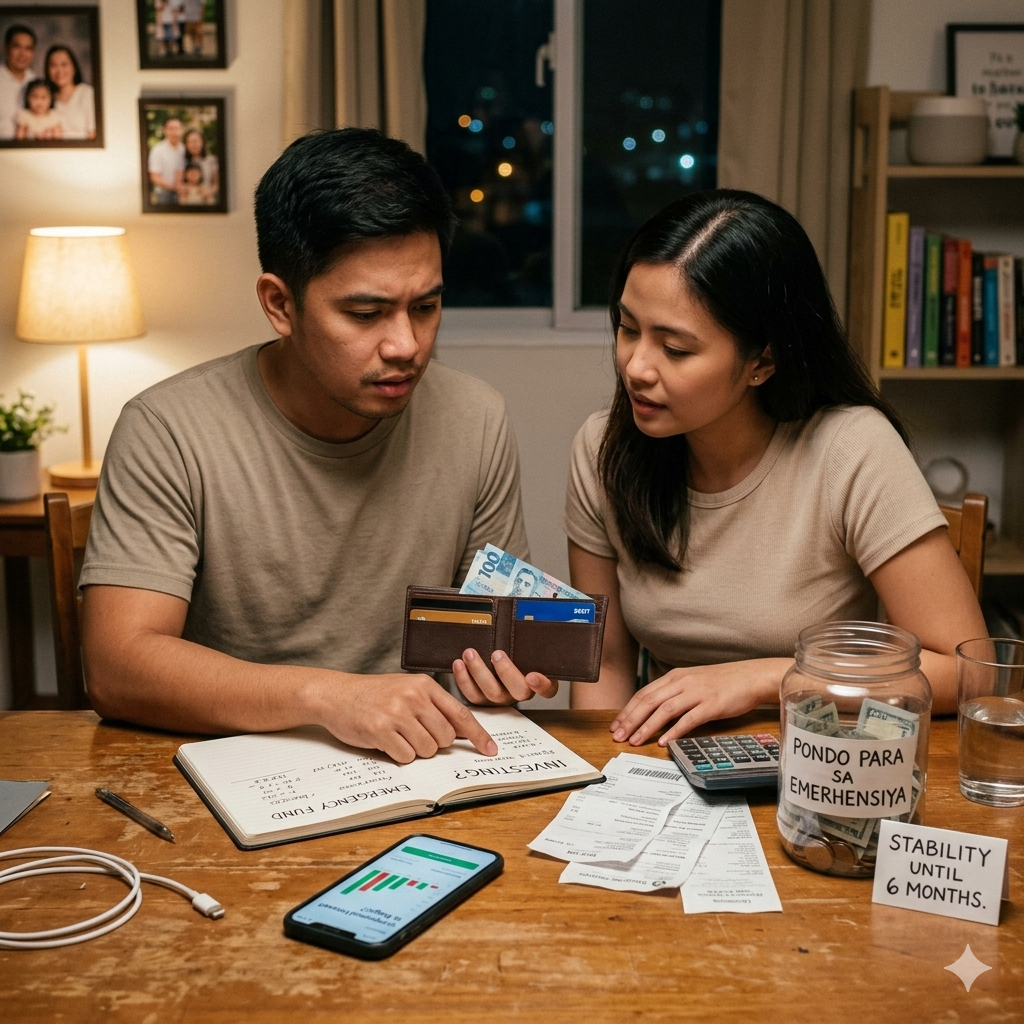
Pag tinanong mo 'to online, expect mo nang magkakagulo ang sagot.
"Build your emergency fund first! Wag ka mag-invest kung wala kang safety net."
"Invest early! Time in the market beats everything. Sayang ang compound interest!"
Pareho silang confident. Pareho silang may point. At pareho silang incomplete.
Here's the thing: most financial advice — especially the kind that goes viral — assumes a very specific kind of life. Stable job. Predictable salary. No one depending on you financially. Expenses that don't randomly spike because your mom got hospitalized or your sibling needs tuition money.
Pero for many Filipinos, that's not reality. You're juggling obligations. Your income might be irregular. Your family treats you like a second ATM. And you're trying to figure out how to get ahead financially while also not drowning in the present.
So which comes first — emergency fund or investing?
The honest answer: it depends on your actual situation. And this article will help you figure that out, without the one-size-fits-all advice that makes you feel bad for not fitting the mold.
If saving anything at all already feels impossible, you might want to start here first: 👉 Why Most Filipinos Struggle to Save (And It's Not Discipline)
Let's get clear on what an emergency fund is — and what it isn't.
An emergency fund is not a wealth-building tool. Hindi 'to meant para yumaman ka. It's not there to grow your money or beat inflation or give you impressive returns.
An emergency fund exists for one purpose: to protect you when life goes sideways.
It absorbs shocks. When something unexpected happens — a medical bill, a job loss, a broken appliance, a family emergency — your emergency fund takes the hit so the rest of your financial life doesn't collapse.
It prevents debt. Without a buffer, most people turn to credit cards, salary loans, or worse — 5-6 lenders — when emergencies strike. An emergency fund means you don't have to borrow at high interest just to survive a bad month.
It buys time. If you lose your job, an emergency fund gives you breathing room to find a new one without panicking. If you get sick, it covers expenses while you recover. It's not about getting rich. It's about not getting destroyed.
According to BSP's financial literacy materials, they recommend setting aside three to six months of living expenses as an emergency fund before you start investing. That's not random advice — it's recognition that without a buffer, you're vulnerable to exactly the kinds of shocks that derail Filipino households every day.
You've probably heard this a thousand times: "Time in the market beats timing the market." "Start investing young — compound interest is magic." "Every year you delay is money lost."
And honestly? That advice isn't wrong. It's just incomplete.
Time in the market is powerful — when you can actually stay in the market. But investing before you're financially stable can backfire in ways that "invest early" advocates don't always mention.
Here's what happens when you invest without a safety net:
Investments don't help if you have to liquidate them at the worst time. The whole point of investing is to let your money grow over years or decades. If you might need that money in six months because you have no buffer, you're not really investing — you're gambling.
A lot of the "invest first" content you see online comes from creators whose financial reality is very different from most Filipinos.
They might have parents who are financially independent. They might live rent-free. They might have health insurance that actually covers things. They might have never experienced sending a chunk of their salary home every month.
But for many of us, the reality looks more like this:
Supporting parents or siblings. You're not just saving for yourself — you're funding other people's lives too. That's not a character flaw; that's Filipino family culture. But it does mean your "spare money" is a lot less spare than advice assumes.
Irregular income. Maybe you're a freelancer. Maybe your salary depends on commissions or overtime. Maybe your contract gets renewed every six months and you're never quite sure what's next. Stability? What stability?
Health expenses not fully covered. PhilHealth helps, pero hindi sapat. One hospitalization can cost tens of thousands out of pocket. Medicines, lab tests, private rooms — these add up fast, and most Filipinos don't have comprehensive health insurance.
Job insecurity. Contractualization, layoffs, companies closing — these aren't rare events. They're part of the landscape. Losing your job isn't a hypothetical risk; it's something you or someone you know has probably already experienced.
In this environment, liquidity matters. Having money you can access immediately — not locked in a mutual fund or stock portfolio that takes days to liquidate — isn't just nice to have. It's essential.
According to BSP data, 81% of Filipinos who save say they're saving for emergencies. Only 12% save primarily for retirement. That's not because Filipinos don't understand investing. It's because they know, from experience, that emergencies are constant and unpredictable.
Let's be specific. When should you prioritize building an emergency fund over investing?
Stability comes before optimization. Walang point na i-optimize ang returns mo kung buong buhay mo stressed ka.
👉 Why Your Savings Keep Getting Used (And How to Fix It)
Now, does this mean you should never invest until you have a perfect six-month emergency fund? Hindi naman.
Investing earlier may be reasonable if:
Even then, start small. You don't need to go all-in on stocks or crypto. A small monthly investment — ₱1,000, ₱2,000 — lets you learn the mechanics without betting money you can't afford to lose.
Here's something the debates often miss: this isn't an either/or decision that you make once and stick with forever.
Life changes. Your income changes. Your responsibilities change. And your financial priorities should change with them.
Many people do something like this:
Phase 1: Build a small emergency buffer — maybe one to two months of expenses. Just enough that a minor emergency won't wreck you.
Phase 2: Start light investing while continuing to grow the emergency fund. Maybe 70% of your savings goes to the emergency fund, 30% to investments.
Phase 3: Once you hit three to six months of expenses in your emergency fund, shift more aggressively toward investing.
And then life happens. You use your emergency fund for an actual emergency. You rebuild. You adjust.
The point is flexibility. You don't have to pledge allegiance to one approach forever. You're allowed to adapt based on what's happening in your life right now.
Okay, so if you're prioritizing emergency fund first — how much is enough?
The standard advice is three to six months of essential living expenses. That's what BSP recommends. That's what most Philippine financial institutions suggest. For freelancers and breadwinners with multiple dependents, some advisors push it to six to twelve months.
But here's the thing: those numbers can feel overwhelming. If you're earning ₱25,000 a month and spending most of it on essentials, saving ₱75,000 to ₱150,000 feels impossible. And if it feels impossible, you won't even start.
So ignore the dramatic targets for now. Think in steps:
Progress beats perfection. Mas importante na may momentum ka than waiting for the "perfect" amount before you feel good about yourself.
👉 How Much Savings Should You Actually Have in Your 20s and 30s?
Let's talk about something that doesn't show up in spreadsheets: how an emergency fund changes the way you feel.
An emergency fund reduces anxiety. Hindi mo na kailangang mag-panic every time something breaks or someone gets sick. You know you can handle it. That peace of mind is worth more than a few percentage points of investment returns.
It improves your decision-making. When you're not financially desperate, you make better choices. You negotiate salary better because you're not terrified of losing your job. You don't stay in toxic workplaces out of fear. You think longer-term because you're not just trying to survive the week.
It prevents desperate choices. No emergency fund means you might take a predatory loan, sell something valuable at a loss, or make a career move you'll regret — just because you needed cash immediately.
These benefits are real. They affect your relationships, your career, your mental health. Pero hindi sila na-compute sa investment calculator.
👉 The Difference Between Saving Money and Feeling Secure
You don't have to look far to find stories of people who invested before they were ready.
Online forums are full of posts like:
The common thread? They didn't have a buffer. They were investing money they might need, not money they could truly afford to leave alone for years.
That loss — the forced selling, the penalty fees, the emotional toll — often hurts more than delayed investing ever would. A few years of "missed" compound interest is nothing compared to losing half your capital because you had to withdraw during a downturn.
Still not sure what to prioritize? Ask yourself these questions:
The goal isn't to follow a rule. The goal is to be honest about your situation and build accordingly.
Here's the thing people don't say enough: you don't lose by delaying investing. You lose by being forced into bad decisions.
Selling investments at a loss because you needed cash? That's a loss. Taking a high-interest loan because you had no buffer? That's a loss. Staying in a terrible job because you can't afford to quit? That's a loss — of time, of opportunities, of your wellbeing.
An emergency fund prevents those losses. It gives you options. It gives you the ability to wait, to think, to choose wisely instead of desperately.
Build stability first. Hindi 'yan boring or "mabagal." That's the foundation that makes everything else possible. Once you're stable, growth follows more easily — and more sustainably.
Investing can wait a year or two. Your financial peace of mind can't.