Savings Account vs Time Deposit: What's Better for Filipinos?
The real differences for Filipinos — and how to choose based on flexibility, goals, and peace of mind.
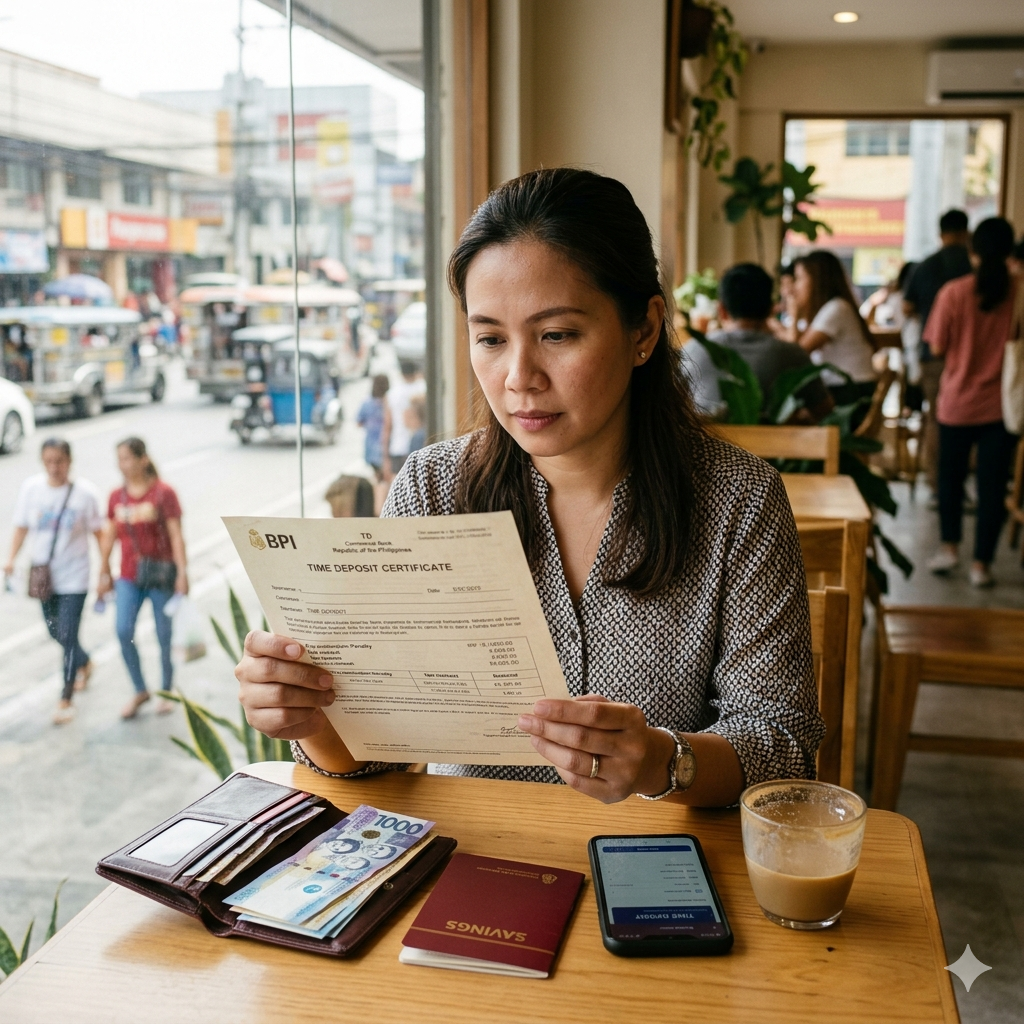
Most banks describe time deposits in one sentence:
"Lock your money, earn higher interest."
That's accurate. It's just not complete.
The part that gets left out — the penalties, the fine print, the situations where locking money quietly backfires — is exactly where most frustrations come from. People open a time deposit thinking it's straightforward, then discover the details later, usually at the worst possible moment.
This guide explains how time deposits actually work in the Philippines.
👉 Still figuring out whether a savings account or time deposit is right for you? Start here: Savings Account vs Time Deposit: What's Better for Filipinos?
Strip away the jargon, and a time deposit is this:
You give the bank a fixed amount of money. You agree not to touch it for a fixed period. In exchange, the bank pays you a fixed interest rate that's higher than what a regular savings account offers.
"Pera na ipa-park mo sa bangko for a set time, bawal galawin, kapalit mas mataas at guaranteed na interest."
At the end of the term, called the maturity date, you get your original amount back plus the interest earned, minus the mandatory 20% final withholding tax that applies to all deposit interest in the Philippines.
That's the basic structure. Simple enough.
But the details inside that structure are where things get interesting.
Before you open a time deposit, these are the terms that actually matter:
This is the section most people wish they had read before opening a time deposit.
Early withdrawal is allowed by most Philippine banks — but "allowed" doesn't mean "free."
Here's how the penalty typically plays out:
And here's the part that catches people off guard: you still pay 20% final withholding tax on whatever interest remains after the penalty recalculation. In the worst cases, the effective return on your money ends up close to zero.
You don't lose your principal. But you can lose almost all the interest you expected to earn.
In some scenarios, if you had simply left the money in a regular savings account the whole time, you would have come out with more because at least you weren't penalized for accessing it.
"Hindi mawawala ang pera mo, pero 'yung interest na inaasahan mo? Maaaring wala."
This is why understanding the penalty structure matters more than the advertised rate. A 5% time deposit that you end up breaking at month three can easily turn into a 0.35% outcome. The headline number means nothing if your circumstances change.
👉 Savings Account vs Time Deposit: What's Better for Filipinos? — when a time deposit makes sense and when it doesn't.
There are real reasons Filipinos gravitate toward time deposits, and they're worth taking seriously.
These are legitimate strengths. A time deposit is genuinely low-risk in the traditional financial sense.
The important distinction is between safe and suitable. A product can be safe from market risk while still being the wrong choice for your specific situation. Someone with no emergency fund can open a time deposit at a perfectly reputable bank and still end up worse off — not because the product is bad, but because their circumstances weren't ready for it.
The reason time deposits offer higher rates than savings accounts is structural: you're giving up access in exchange for yield. The bank can lend your money more confidently because it knows when it will get it back.
That trade-off works in your favor in two ways. It earns you more interest. And for people who tend to drain their savings whenever a sale drops or a "biglang gusto" arises, the lock physically removes temptation. Some people genuinely use time deposits as a forcing function for savings discipline, and it works.
But the same trade-off works against you the moment you actually need that money.
In an emergency — sudden illness, job loss, or a family member needing help — locked money creates a painful choice: break the deposit and absorb the penalties, or borrow at a much higher rate while your own money sits inaccessible in a bank.
That's not a hypothetical. It's one of the most common stories Filipinos share when explaining why a time deposit didn't work out for them. The problem usually wasn't the product. It was opening one before the rest of the financial foundation was in place.
👉 Why Your Savings Keep Getting Used (And How to Fix It)
The mechanics are the same whether you're at a branch or on an app. Fixed-term, fixed-rate, penalties for early withdrawal. That structure doesn't change.
What does change:
The core question — "How long can you genuinely not touch this money?" — applies equally regardless of which bank you use. A higher rate at a digital bank doesn't change the risk of opening a time deposit before you're financially ready for it.
The decision is still about liquidity vs discipline. Not app vs branch.
👉 Compare time deposit rates and terms
Time deposits are well-designed products that millions of Filipinos use effectively. They're also regularly opened at the wrong time, by the wrong person, for the wrong reasons.
A time deposit is for money you can forget, not money you might need.
If you're placing money in a time deposit and still quietly worrying about whether you'll need it before maturity, pay attention to that feeling. That discomfort is information.
Before placing a time deposit, ask yourself one question honestly:
"If I lost my income tomorrow, would I regret locking this money?"
If the honest answer is yes — even a small yes — don't lock it yet.
This isn't about being overly cautious. It's about the math. Early withdrawal penalties are designed to be painful enough to discourage breaking deposits before maturity. If there's a real chance you'll need to access the money, opening a time deposit means you're planning to pay those penalties.
The right time to open a time deposit is after your emergency fund is fully funded and sitting in a liquid savings account. After you've identified money with a defined purpose and a timeline you're genuinely confident about.
Not before.
👉 Emergency Fund First or Investing First? (A Filipino Reality Check)
Time deposits are sometimes treated as a sign of financial progress — like opening one means you've officially figured out money. That framing isn't helpful.
A time deposit is a specific tool for a specific situation: parking money you genuinely won't need for a defined period, earning a predictable return, protected from both market swings and your own impulses.
Used in that context, it works well. Used as a substitute for emergency savings, or opened before your cash flow is stable, it creates exactly the kind of stress it was supposed to eliminate.
The goal isn't to have a time deposit. The goal is to have the right setup for where you actually are right now.
Sometimes that includes a time deposit. Often it doesn't — yet.