Paying the Minimum vs Paying in Full
Understand the real cost of minimum payments and why paying in full matters.
Here's something you notice pretty quickly on r/PHCreditCards:
The same questions come up over and over. The same worries. The same misconceptions.
And most of the time, people aren't making credit card mistakes because they're reckless or irresponsible. They're making mistakes because they were given bad information.
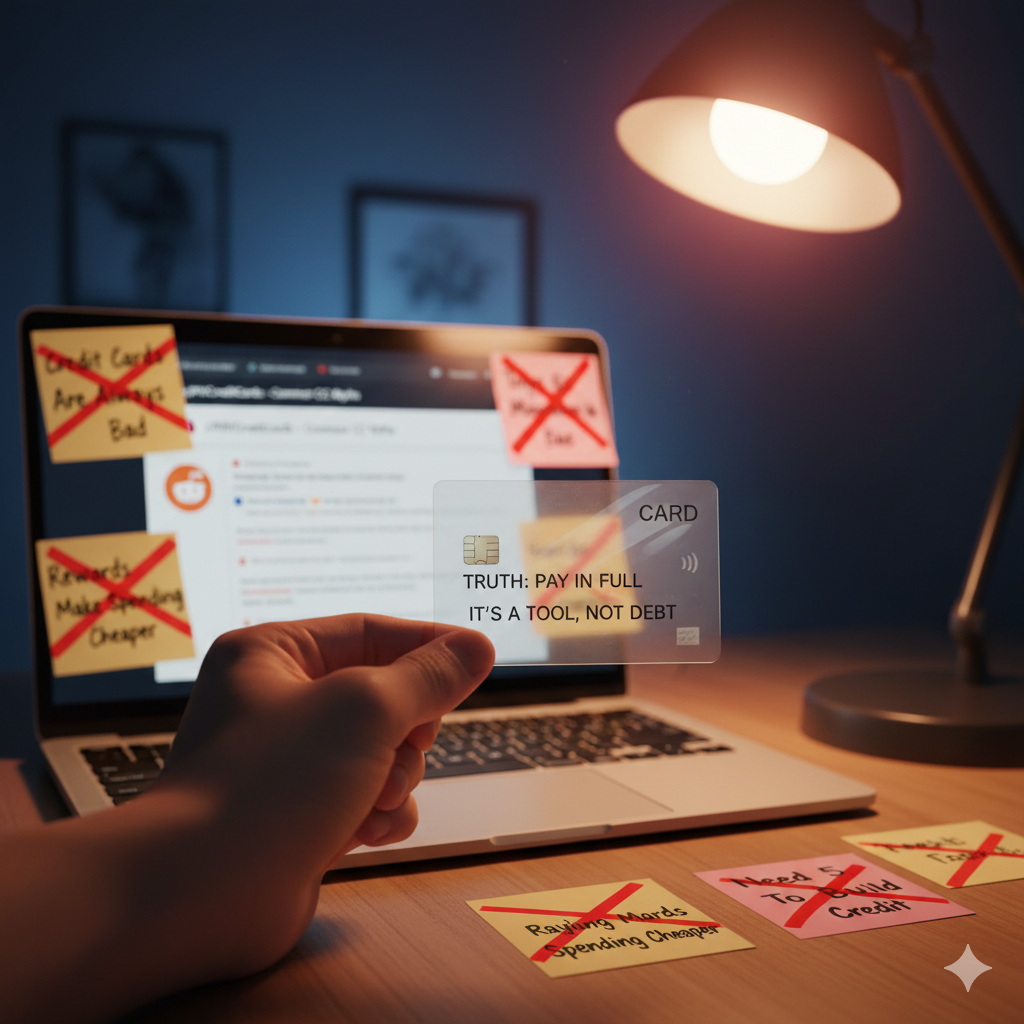
Someone told them paying the minimum is fine. Someone said you need five cards to build credit. Someone convinced them that rewards make everything cheaper.
These myths sound reasonable enough that people believe them. And by the time they realize something's wrong, the damage is already done.
This article breaks down the most common credit card myths Filipinos still believe, backed by what banks actually say, what BSP clarifies, and what real users report on Reddit.
This is probably the most persistent myth out there.
People hear horror stories. Someone's tito ended up in massive debt. A friend got buried in interest charges. Social media is full of cautionary tales about credit cards ruining lives.
So the conclusion becomes: credit cards are evil. Stay away from them completely.
The truth:
Credit cards are tools. They're neutral. Neither inherently good nor inherently bad.
BPI explicitly says this in their myth-busting articles: "Credit cards are just a tool, neither good nor bad on their own. It all depends on how you use them."
Maya's explainer on credit card myths notes that myths and horror stories have made many Filipinos fear credit cards, even though they can actually help with managing expenses, building credit history, and earning rewards when used responsibly.
What this means for you:
A misused credit card is absolutely bad. If you're carrying balances, paying interest every month, and stressing over due dates, then yes, that card is hurting you.
But a properly used credit card — one where you pay in full every month, track your spending, and stay within your budget — is just a convenient payment tool that happens to give you some perks.
Fear without understanding leads to avoidance. And avoidance means you never learn how to actually use the tool properly.
The real lesson:
Don't avoid credit cards out of fear. Learn how to use them correctly. The problem isn't the card. It's the lack of system around it.
This myth is especially dangerous because it sounds reasonable.
The bank says you need to pay at least the Minimum Amount Due. So if you pay the minimum, you're being responsible, right? You're meeting your obligation. The bank won't come after you.
The truth:
Paying the minimum keeps the bank off your back, pero it's not "responsible" in the sense of protecting your finances.
BDO defines the Minimum Amount Due as the amount you must pay to keep the account current, but not to avoid interest. Interest is charged if you don't pay the full outstanding balance.
BPI's update on Minimum Amount Due explains it the same way: paying only MAD avoids late fees, but finance charges will still apply if you don't settle the total amount due.
What actually happens:
Let's say you have a ₱10,000 balance. Your MAD is around ₱300 to ₱500 (usually 3-5% of the balance).
You pay ₱500. You feel good because you "paid your bill."
But the remaining ₱9,500 starts accruing interest at typical Philippine credit card rates, which can be quite high. Next month, your balance is higher even if you don't spend anything new, because interest got added.
You pay the minimum again. The cycle continues. Your balance barely moves.
What Reddit says:
When newbies on r/PHCreditCards ask "ok lang ba minimum amount due?" the consistent answer is: banks are fine with it operationally, but you'll incur interest and risk long-term debt if it becomes a habit.
The real lesson:
The minimum payment is a safety net for emergencies, hindi default strategy. If you're regularly paying only the minimum, your card is costing you money and you're not actually in control.
This one's subtle, kaya madaming nauuto.
The logic goes: if you get 2% cashback, then everything you buy is effectively 2% cheaper. So the more you spend, the more you "save."
The truth:
Rewards only work if you don't change your behavior and you pay in full.
Maya's myth explainer stresses that credit card fees and interest can be minimized or avoided if you pay in full, but that high interest and other charges can "drain your finances" if you don't understand how they work.
BPI's myth-busting piece says credit cards can be a "game-changer" that rewards you, pero only if you budget, prioritize needs, and pay your bill on time so you don't get hit with interest.
What actually happens:
Scenario 1: You were going to buy ₱5,000 worth of groceries anyway. You use your card, get ₱100 cashback, and pay the full ₱5,000 when the bill comes. The cashback is a genuine bonus.
Scenario 2: There's a promo for 5% cashback on dining. You end up eating out more than usual to maximize the rewards. You spend ₱8,000 instead of your usual ₱4,000. You get ₱400 cashback, but you spent an extra ₱4,000 you wouldn't have otherwise. Net result: you lost ₱3,600.
Scenario 3: You rack up purchases to hit a spending threshold for bonus points. You can't pay in full, so you carry a balance. The interest you pay in one month wipes out months of cashback.
What Reddit says:
Community FAQs on r/PHCreditCards repeatedly warn that rewards are only a bonus if you would have bought the item anyway and if you don't revolve a balance. Otherwise, interest quickly outpaces any cashback or points.
The real lesson:
Rewards don't make spending cheaper. They make responsible spending slightly more rewarding. If your behavior changes because of rewards, you're losing money, not saving it.
This myth probably comes from people seeing others with wallets full of cards and assuming that's what you're supposed to do.
The thinking goes: more cards = stronger credit history = better approvals in the future.
The truth:
One card used well builds credit history just fine.
The r/PHCreditCards wiki on acceptance criteria explains that banks mainly look at income, employment, existing relationships with the bank, and your record of paying on time. It doesn't say you need multiple cards to be approved elsewhere.
BPI's own myth article actually addresses a related misconception. They clarify that while having multiple cards can be useful if you have specific goals, what really matters is responsible use, budgeting, and on-time payments.
Reddit discussions highlight that a single card, used regularly and paid on time, is enough to build a positive history and get higher limits or new cards over time.
What actually happens:
Having one card and paying it in full every month for a year shows banks you're reliable. That's what builds your history.
Having five cards and juggling payments, missing due dates, or carrying balances on all of them makes you look risky, even if you technically have "more credit history."
The real lesson:
Focus on managing one card well before you even think about a second. Quantity doesn't build credit. Consistency does.
This myth causes a lot of unnecessary panic.
Someone misses a due date by a few days. They immediately think their credit is destroyed forever. They spiral into anxiety thinking they'll never get approved for anything again.
The truth:
One mistake has consequences, pero it won't destroy you. What matters is how quickly you catch up and whether it becomes a habit.
Bank materials on MAD and late fees from BDO and BPI show that missing or underpaying a due date leads to late payment fees and finance charges. They talk about "accounts becoming past due" over time, not instant permanent ruin.
r/PHCreditCards users often tell newbies that a single late payment can hurt — you'll get hit with fees, and if it's significantly late, it might get reported as a delinquency. But patterns of repeated late or minimum payments are what really damage your profile.
BSP's consumer-protection materials focus on educating consumers to avoid persistent delinquency and over-indebtedness, again implying that it's ongoing behavior, not a single slip, that creates serious problems.
What actually happens:
You miss a due date. You get charged a late fee, maybe ₱500 to ₱1,000. If you were carrying a balance, interest accrues. Not great, but not the end of the world.
If you catch it quickly, pay what you owe, and don't let it happen again, that's just a one-time mistake. Banks see thousands of these. It's not a permanent mark of failure.
But if you miss payments regularly, pay late most months, or let your account go delinquent for 60+ days, that's when serious damage happens. That's when banks start reporting you negatively, and that's when future approvals become harder.
The real lesson:
One late payment is a mistake. A pattern of late payments is a problem. Don't panic over the first. Just fix it and don't let it become the second.
This one comes up a lot on r/PHCreditCards, so it's worth addressing even if it wasn't on the original list.
Some people treat their credit limit like it's their own money sitting in an account. "I have a ₱50,000 limit, so I have ₱50,000 to spend."
The truth:
Your credit limit is not your savings. It's not your money. It's the bank's money, and you owe back everything you spend.
A popular Reddit thread on misconceptions explicitly calls this out: your credit limit is a borrowing cap, not a balance you own.
What this means:
Just because you have a ₱50,000 limit doesn't mean you should spend ₱50,000. That's ₱50,000 you'll have to pay back, ideally in full, by the due date.
If you can't afford to pay ₱50,000 in cash right now, you can't afford to spend ₱50,000 on your card either.
The real lesson:
Your credit limit is a ceiling, not a target. Spend based on what you can afford to pay back, not based on what the bank is willing to let you borrow.
These myths stick around kasi they sound just reasonable enough to believe.
"Paying the minimum is fine" — well, the bank accepts it, so it must be okay, right?
"Rewards make things cheaper" — math says 2% back is a discount, so why wouldn't it work?
"More cards = better credit" — more history should be better, logically.
But credit cards don't operate on surface-level logic. They operate on systems, behavior patterns, and compounding math. And kung di mo gets yung deeper mechanics, the myths fill in the gaps with wrong information.
That's why financial literacy matters. Not so you can memorize rules, pero so you understand how things actually work well enough that myths don't stick.
Credit card myths persist because people are trying to make sense of something unfamiliar with incomplete information.
The solution isn't to shame people for believing myths. It's to replace myths with clear, simple rules that actually work.
Here are the rules that matter:
Clarity replaces fear. Rules replace stress.
You don't need to be perfect. You just need to understand how the system actually works, so you can make decisions that help instead of hurt.