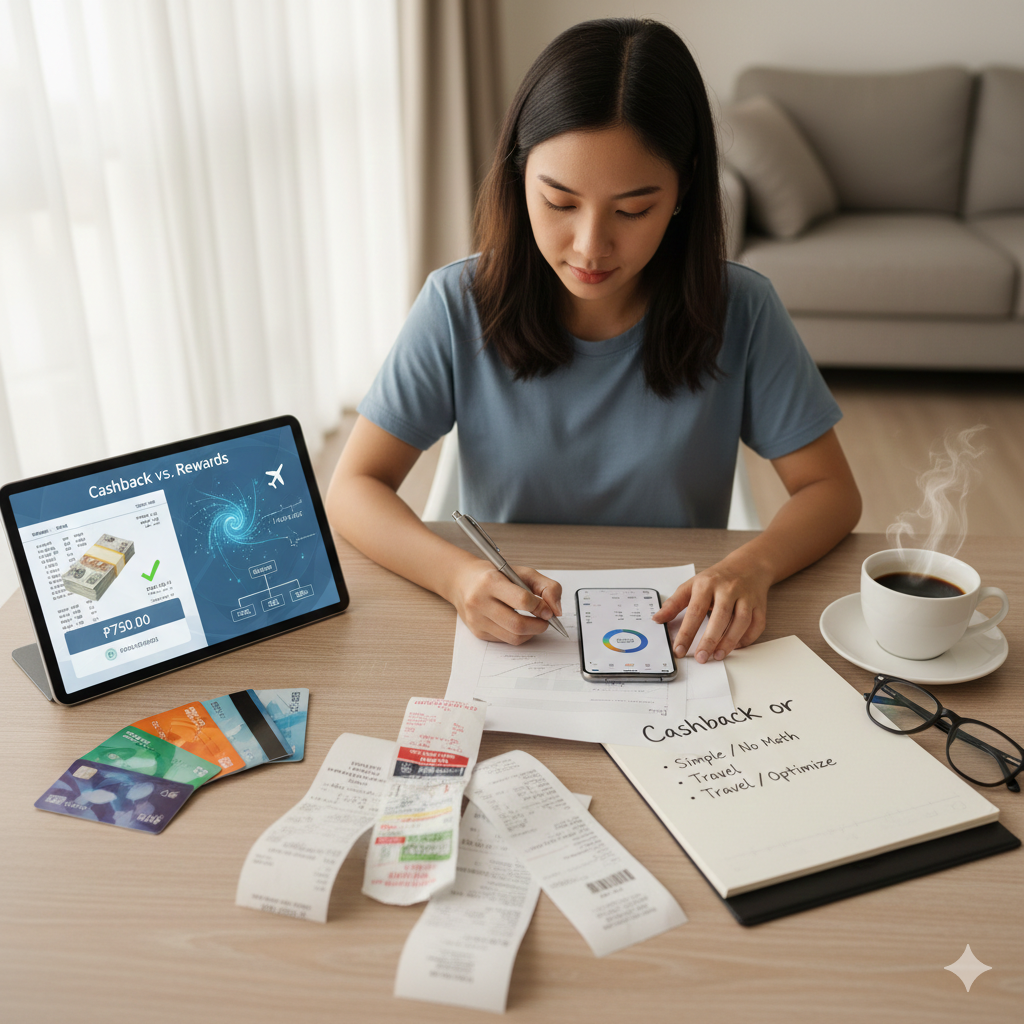
Do Credit Card Rewards Really Matter — Or Is Cashback Better?
Are credit card rewards really worth it? This honest guide explains when rewards help — and when cashback is the smarter choice.

Katrina stands in front of Uniqlo holding a jacket she doesn't need. She already has two similar jackets at home. But her phone buzzes with a notification:
"Earn 5x points on all fashion purchases this weekend!"
She does quick mental math. The jacket costs ₱2,500. With 5x points, that's about ₱125 worth of rewards. "That's basically like getting ₱125 off," she thinks.
She buys the jacket.
Walking to the parking lot, her friend asks, "Were you planning to buy that?"
"Not really. But 5x points! I had to take advantage of the promo."
Her friend doesn't say what she's thinking: Katrina just spent ₱2,500 she wasn't planning to spend in order to "save" ₱125.
This is how rewards programs work. Not by giving you free money, but by changing what you consider a good decision.
Go to r/PHCreditCards and search for posts about rewards. You'll find hundreds of variations on the same sentence:
"I wouldn't have bought this, but at least I earned points."
That sentence should be a warning, not a celebration.
Because here's what it actually means: "I spent money I wasn't planning to spend, on something I didn't originally want, because a reward program convinced me it was smart."
Research shows that paying with credit cards activates the brain's reward centers (the striatum) more strongly than paying with cash. When you add actual rewards programs on top of that (points, miles, cashback), you get a double layer of psychological reinforcement.
Every time you earn rewards, you get a small "win" that conditions you to repeat the behavior, even when the purchase isn't necessary.
This isn't about willpower or intelligence. It's about how human brains process decisions when payment is delayed and sweetened with perks.
Want context on how rewards actually work? Start here: Credit Card Rewards & Miles in the Philippines
The mechanics are simple but powerful.
When you pay cash, you feel the loss immediately. Your wallet gets lighter. The "pain of paying" is real and immediate.
With credit cards, the bill comes later. That delay already reduces friction. But when rewards are involved, your brain focuses on the immediate gain (points, cashback) rather than the full cost you'll pay later.
Lab studies using brain imaging show people are more likely to buy, pay higher prices, and make impulse purchases when using cards with rewards versus cash or even plain credit cards without rewards.
Dennis was at Fully Booked browsing books. He had ₱1,500 budgeted for one book. But his card offered 3x points on bookstores that weekend.
He walked out with ₱4,200 worth of books because "the points made it worth it."
The ₱2,700 extra spending? That wasn't in his budget. The rewards didn't save him money. They cost him ₱2,700 he wasn't planning to spend.
This is the most dangerous pattern.
You see something you don't need. Normally, you'd walk past it. But then you remember your card gives bonus rewards in this category, or you're close to a spending threshold for a bonus, or there's a limited-time multiplier event.
Suddenly, the purchase feels justified. "I'm not just buying this, I'm earning rewards."
Except you are just buying something you don't need. The rewards are a psychological excuse, not an economic benefit.
Maya went to Robinsons to buy groceries. Budget: ₱3,000. But her card had a promo: spend ₱5,000 and get an extra 2,000 bonus points.
She added items she "might need later" until she hit ₱5,000.
The bonus points were worth maybe ₱200. She spent an extra ₱2,000 to earn ₱200. The math is obviously backwards, but in the moment, it felt smart.
The most subtle danger is how rewards change what question you ask yourself.
Without rewards, you ask: "Can I afford this? Do I need this?"
With rewards, you start asking: "Which card earns the most here? Am I maximizing my category bonuses? Should I buy more to hit the threshold?"
That shift in attention moves you from asking budget questions to asking optimization questions. And optimization questions almost always lead to higher spending.
Franco used to have a simple system: check his budget, buy what he needs, done.
Then he got into credit card rewards optimization. Now before every purchase, he checks which card gives the best multiplier, whether he's close to any bonus thresholds, and whether waiting a few days might trigger a better promo.
He spends 10+ hours monthly thinking about rewards optimization. His spending has increased by roughly 30% over the past year. The rewards he earned? Maybe 3% of his total spending.
He's spending 30% more to earn 3% back. That's not optimization, but expensive distraction.
People often ask: "Is cashback safer than points for avoiding overspending?"
The short answer is no. Both can trigger the same psychological patterns.
Points and miles systems are obviously game-like. They have tiers, multipliers, status levels, and aspirational rewards like business class flights.
This gamification is intentional. It pushes users to "optimize" and chase the next level, which usually means spending more.
Rachel got obsessed with accumulating airline miles. She started choosing more expensive restaurants because they gave bonus points. She booked flights through specific portals because of multiplier events. She calculated optimal redemption strategies in spreadsheets.
After 18 months, she'd accumulated enough miles for one international business class flight worth maybe ₱60,000.
She'd also spent an estimated ₱120,000 more than her previous spending patterns across those 18 months, plus countless hours on optimization.
The "free" flight cost her ₱60,000 in extra spending.
Cashback seems more straightforward. "I get 2% back, so everything is 2% cheaper."
But research shows the "free money" framing can still trick you into upgrading purchases or adding extras "because at least I get something back."
The math is simple: if cashback makes you spend 5% more to earn 2% back, you're losing 3%.
But it doesn't feel that way in the moment because you're focused on the gain, not the total cost.
Patrick's cashback card gives 5% back on dining. He used to spend around ₱8,000 monthly eating out.
After getting the card, his dining spending drifted up to ₱12,000 monthly because "I'm getting 5% back anyway."
He's spending an extra ₱4,000 monthly to earn ₱600 back. Net loss: ₱3,400 monthly or ₱40,800 annually.
The cashback didn't save him money. It cost him almost ₱41,000.
Here's the critical insight: even a small reward (1–5% back) can trigger behavior that causes you to spend significantly more than you otherwise would.
The reward seems harmless. "It's just a little bonus." But the bonus changes your behavior in ways that cost far more than the bonus is worth.
Recognizing these patterns? Read: Do Credit Card Rewards Really Matter — Or Is Cashback Better?
Rewards aren't universally bad. They fail in specific conditions and work in others.
If you already know what you're buying before you walk into the store, rewards can add passive value without changing behavior.
Lorna buys ₱15,000 in groceries monthly no matter what. She has a budget, a list, and she sticks to both.
Her cashback card gives her 3% back on groceries. That's ₱450 monthly or ₱5,400 annually.
The card didn't make her buy more groceries. She was already spending ₱15,000. The cashback is genuinely free money on top of spending she was doing anyway.
Credit cards in the Philippines charge around 2% monthly interest (up to 24% annually per BSP's cap). If you're carrying balances, interest charges will obliterate any rewards value.
Rewards only create real value if you never pay interest.
The safest way to use rewards is to forget they exist until redemption time.
Choose a card with simple rewards structure, use it for planned purchases, ignore the points/cashback accumulation, pay in full every month, redeem once or twice a year.
If you're checking your points balance weekly, calculating optimal spend patterns, or timing purchases around promo periods, rewards are controlling you.
The moment you start making purchase decisions based on rewards ("I should buy this because bonus points"), rewards have stopped being a benefit and started being a cost.
Want to compare your options? Read: Cashback vs Rewards Cards: What Reddit Users Actually Prefer
These phrases from r/PHCreditCards indicate rewards are controlling spending, not supporting it:
If you've said any of these sentences, rewards are costing you money even if it doesn't feel that way.
Here's the rule that actually works:
"If I wouldn't buy this without rewards, I don't buy it."
Rewards should be invisible during purchase decisions. You decide what to buy based on budget and need. The rewards happen automatically in the background as a small bonus.
If you're ever thinking "should I buy this for the rewards?" the answer is automatically no.
Nathan follows this strictly. He has a monthly budget. He knows what he needs to buy. He uses his cashback card for those purchases and completely ignores the cashback percentage during the purchase decision.
At the end of the year, he gets around ₱8,000 in cashback. It's genuinely free money because it didn't change any of his purchase decisions.
His officemate who "optimizes rewards"? Gets around ₱12,000 in rewards annually but spends roughly ₱50,000 more than Nathan on similar categories.
Net: Nathan is ₱38,000 ahead.
The uncomfortable truth about credit card rewards is that discipline beats optimization every single time.
Someone who spends ₱20,000 monthly, pays in full, and earns 1% cashback (₱200) is in better financial shape than someone who spends ₱28,000 monthly chasing 3% rewards (₱840).
The first person spends ₱240,000 annually and gets ₱2,400 back.
The second person spends ₱336,000 annually and gets ₱10,080 back.
The first person is ₱96,000 richer despite earning ₱7,680 less in rewards.
Rewards are a distraction from what actually matters: spending less than you earn and paying your balance in full.
You don't need rewards to win financially.
In fact, for most people, chasing rewards actively prevents winning financially because it encourages exactly the behavior you should avoid: spending more.
The best financial strategy isn't "maximize rewards." It's "minimize unnecessary spending, pay in full every month, let rewards happen passively if they happen at all."
Katrina from the beginning eventually realized she'd accumulated seven jackets over six months, all purchased during "bonus point events." She'd spent over ₱15,000 on jackets she rarely wore to earn maybe ₱750 in rewards value.
She switched to a simple approach: buy only what's on her list, use her card for the convenience, ignore the rewards entirely until redemption time.
Her spending dropped by 35%. Her rewards dropped by maybe 20%. Net result: she's saving thousands monthly.
That's what winning looks like. Not maximizing points. Minimizing waste.
If rewards are making you spend more than you would with cash, they're not rewards. They're costs.
Want to build better money habits? Read: Smart Money Habits for Young Filipinos